

Finding the Signal in the Noise
Shot tracking offers golfers more data about their games than they’ve ever had before. We can learn exactly how far each of our clubs actually goes – on the course, not on a simulator. We can learn how good our putting is, how woeful our chipping is, and our scoring average on par 4s over 425 yards.
The problem is that trying to get practical tips out of this data is like trying to drink out of a fire hose. Or at least it used to be. Thanks to the Shot Scope 6, there are six simple stats you can you use to improve your game and drop your handicap.
Still not shot tracking? Check out the Shot Scope V5 HERE
This Lesson Is For You If:
You feel overwhelmed by your shot tracking data
You want a practical plan for lowering your scores
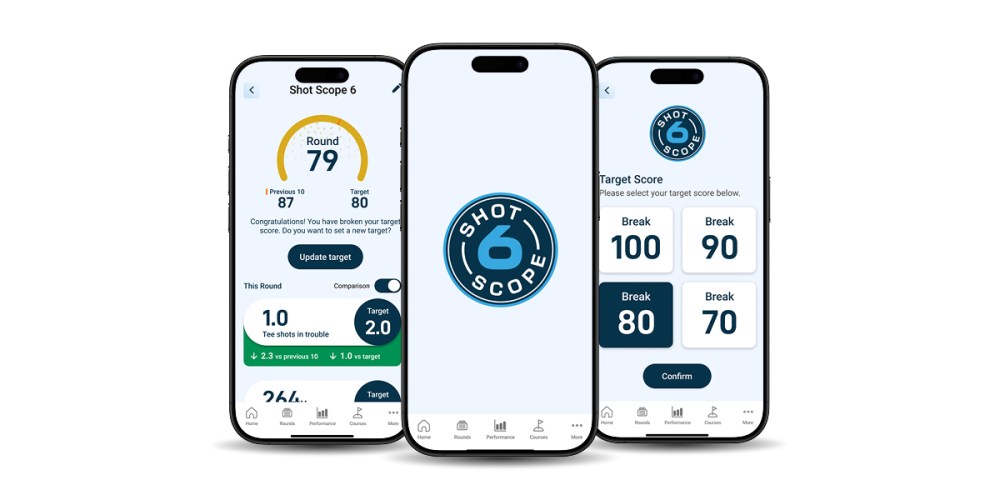
The Shot Scope 6
The Shot Scope 6 are the six easy to understand statistics that Shot Scope has identified as being most closely tied to scoring. Below, I’ll explain each one, show you the stats, and give you a practical suggestion for how to improve in that area.
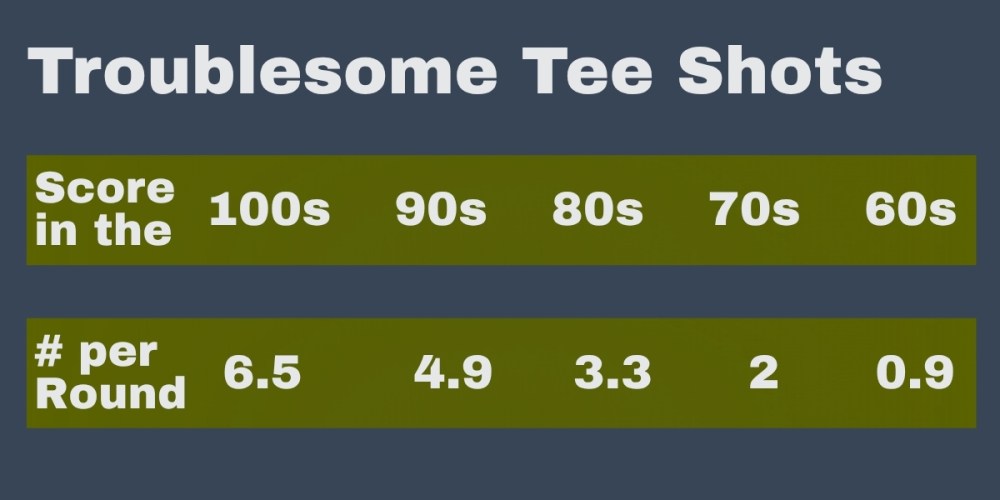
Troublesome Tee Shots
Shot Scope defines Trouble Tee Shots as those that A) result in a lost ball or penalty drop or B) are hit into a bunker, thick rough, or trees so the player is forced to hit a recovery shot. Every golfer can intuitively understand why these are so detrimental to scoring. If you’re re-teeing or playing your second shot sideways, making birdies is impossible and pars are very, very difficult.
You can see in the data that removing roughly 1.5 Troublesome Tee Shots per round correlates with a ten stroke improvement in scoring. It’s really important to keep the ball in play off the tee. Per Shot Scope, Troublesome Tee Shots lead to double bogey 58% of the time!
How to Improve
Do NOT stop hitting driver* – I explain why HERE.
Instead, make hitting straighter drives your #1 priority when you practice. Work with a coach if needed, or check out our full swing lessons HERE. Getting your driver on the right track is the single most important step in significantly lowering your handicap.
*I will acknowledge that, while I fully endorse the data-driven approach of hitting driver as much as possible, there is something to be said for understanding the hole in front of you. If hitting driver brings trouble into play, throttle down to 3W or hybrid. Eliminating penalties off the tee can be as much about decision making as it is about your swing.
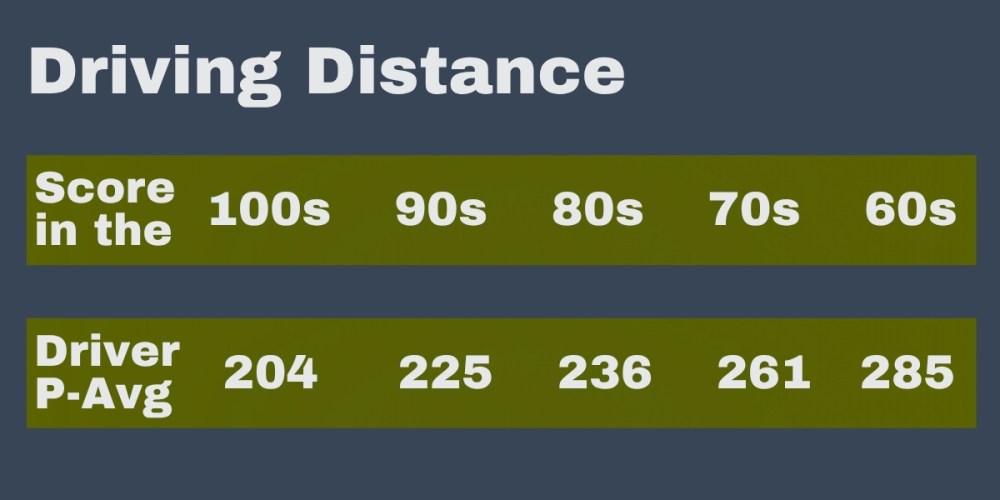
Driving Distance
It’s easier to hit the green when you’re closer to it, so driving it farther is a big advantage. I really don’t think this one needs any further explanation.
How to Improve
There are two ways to approach this problem. First – and this is more applicable for the higher handicap players – you can improve your strike quality and direction. Straightening out a sideways miss will add loads of distance without any added swing speed.
The second piece of the equation is swinging the club faster. Get a training tool like SuperSpeed [review HERE], track your progress with the Shot Scope LM1 [review HERE], and you’ll see your driving distance improve. Adding just 1 MPH of swing speed can, when fully optimized, add 4 yards to your drives. Golfers who have never done speed training can expect to add several MPH to their swing in very little time.
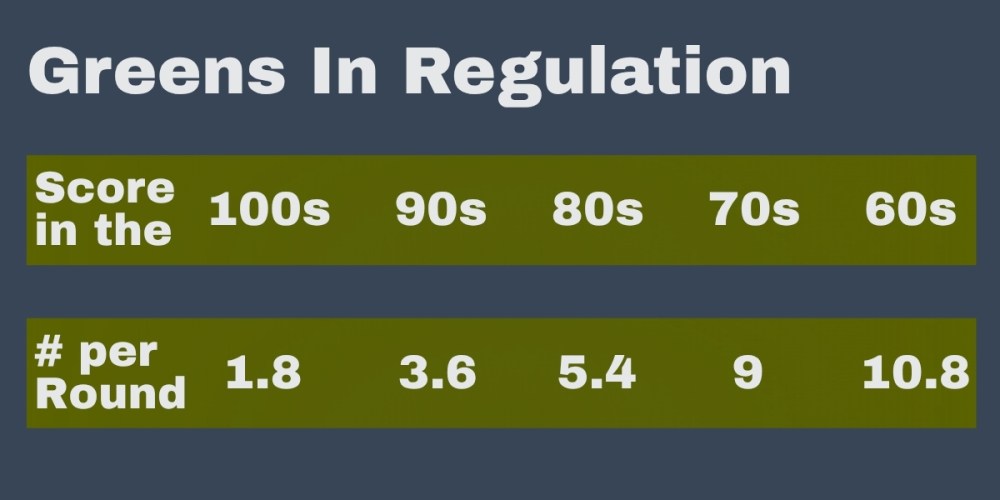
Greens in Regulation
GIR is the king of stats. It’s the single statistic most closely tied to score [more on that HERE]. When you’re hitting greens, you’re going to have a hard time making worse than bogey, and that dramatically raises the floor on your scoring. Similarly, when you’re hitting greens, you have birdie chances, so your ceiling goes up, too.
You can see above that the biggest jump in GIR happens when you move from the 80s to the 70s. Until that point, all you need to do is hit 2 more GIR to see a substantial improvement in your score.
How to Improve
If you’re already tidied up your driving (it’s hard to record a GIR when you’re hitting three off the tee), focus on making the most of your opportunities when you have a short iron in your hand. Nobody hits many greens from long distance – scratch players hit less than 1/3 greens from 175-225 yards – so you don’t need to become Tiger with a 4I. Concentrate on hitting the middle of the green with your 8I-PW, and you’ll see those GIR stats improve.
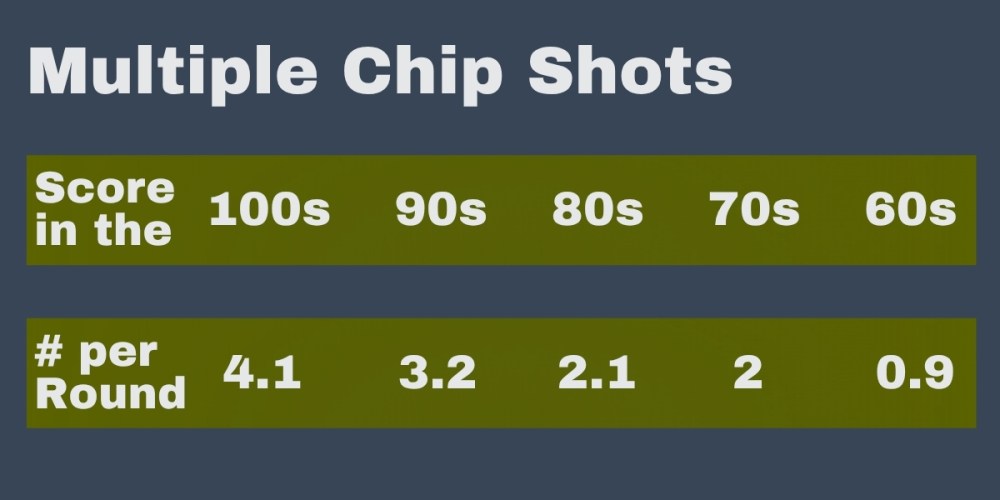
Multiple Chip Shots
This stat represents failing to hit the green from inside 50 yards. As you can see above, golfers at every level do this, even those highly skilled players shooting in the 60s. The problem is that higher handicap players do it more. From 100 to 90 to 80, removing one multi-chip per round is correlated with a ten stroke improvement. This isn’t surprising when we learn that a multi-chip hole ends with a double bogey 38% of the time.
How to Improve
While technique and skill are certainly big parts of the equation, strategy plays a huge role. As I discussed in detail HERE, most golfers only see the portion of the green between their ball and the flag. Especially if you’re a higher handicap player, stop trying to hole your chips and stop worrying about getting up and down. Get your ball onto the green and play from there. Play a simple reliable shot – using a putter is often a great option – and get the ball on the dance floor.
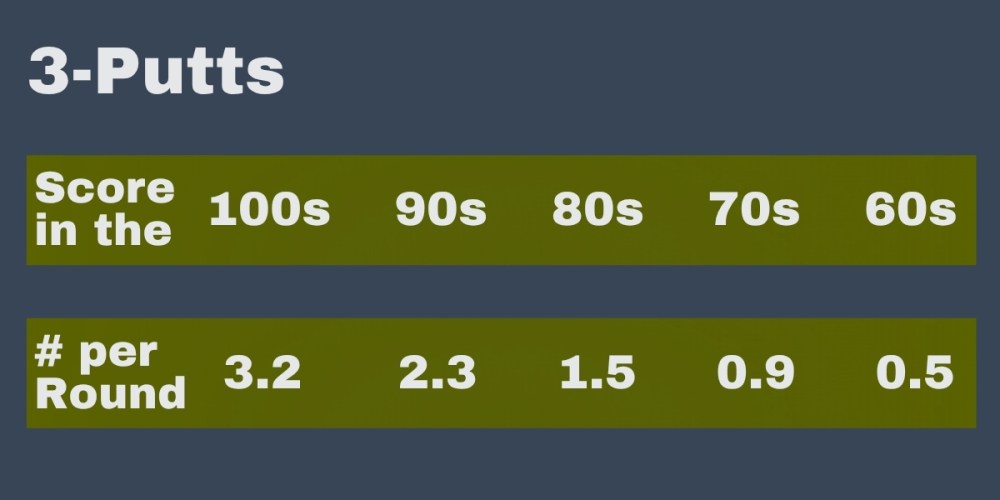
3-Putts
The bane of every golfer is also one of the stats most closely connected to scoring. As you can see above, single digit and better players are three-putting less than once per round while the highest handicap players are doing it two or three times. You’ll score a double bogey or worse about 1/3 of the time that you three-putt, so minimizing these mistakes is critical.
How to Improve
Learn how to consistently roll the ball thirty feet on a flat green. If you have a dialed-in thirty foot putt, you can build off that to hit twenty footers, forty footers, and putts up and down slopes. Avoiding three putts is primarily about getting those long putts into stress-free range, and building that distance control starts with having one putt you can absolutely rely on.
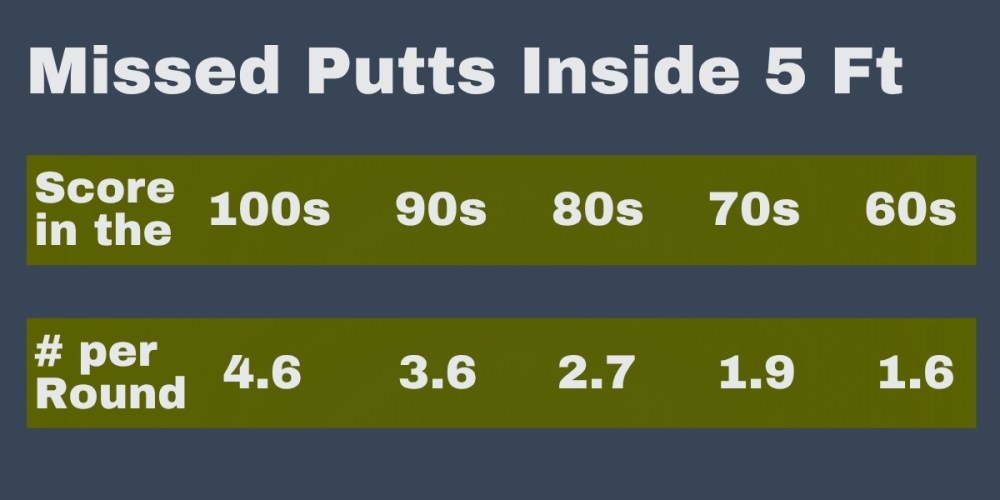
Putts Missed Inside 5 Feet
If you think it doesn’t matter that you scoop up all those “gimmes,” you’re dead wrong. Even the best players miss more than one putt per round from inside five feet. If you’re keeping an honest score, you need to hole out every putt, and if you want that honest score to be better, you need to stop missing so many shorties. While it’s one of the silliest things about golf, those short putts count exactly the same on your scorecard as your huge drives.
How to Improve
To get better at making short putts on the course, you need to practice with pressure. Force yourself to make a certain number of putts in a row – and don’t hit the same putt more than once. Another game you can play is “Makes are +1, Misses are -2” and you putt until you hit a goal score. Take your time, read each putt, and treat it with the importance of a putt that will count toward your score.
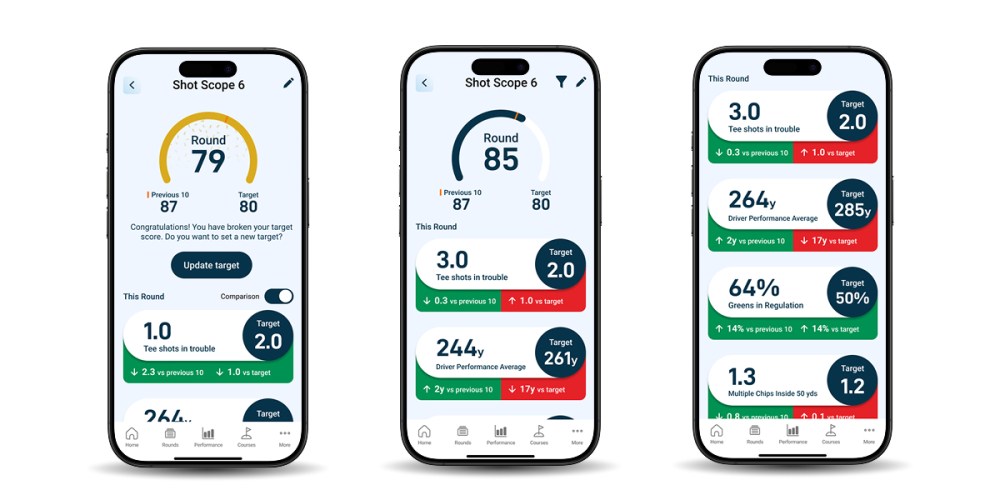
Your Personal Improvement Plan
Once you’ve got your Shot Scope 6 data, the first thing you’ll want to do is figure out where your biggest gap is. By “gap” I mean the difference between your stats and those of the group you want to be in. For example, if you want to shoot in the 70s and you are missing six putts per round inside five feet, that’s a huge gap and the area where you are likely to see the best ROI. If your stats already match the group you want to be in, you can leave that alone and focus your time elsewhere.
Another thing to consider is how much time you have to work on your game. Improving your short putting is a lot easier than fixing a nagging slice. If you don’t have time for regular lessons or practice, focus your energy on the putting stats and on making the best strategic decisions on the course.
Bonus Takeaway
One of the most important things you can take away from this lesson is that even the very best players make mistakes of all kinds in every round. To quote Dr. Bob Rotella, “Golf is not a game of perfect.” While you will have rounds without a 3-putt or a Troublesome Tee Shot, you can’t expect those things. Do your best to minimize your mistakes, but don’t get discouraged by the false idea that perfect golf exists.

He founded Plugged In Golf in 2013 with the goal of helping all golfers play better and enjoy the game more.
Matt lives in the northwest suburbs of Chicago with his wife and two daughters.
- Cobra 3DP Tour Irons Review - September 17, 2026
- Mitsubishi Diamana RB Hybrid Shaft Review - September 15, 2026
- Does PUREing Matter for Slow Swingers? – Golf Myths Unplugged - September 14, 2026









4 Comments
I love the Shotscope product line (X5 watch, ZR LRF, LM1) and especially their outstanding service. As someone in his late 70’s, shooting mid 80’s, one facet of the “6” for me to break 80 that is questionable is the drive which states I should be hitting 261 yds. Not even on a great day, with a downwind howling wind and a downhill fairway.
On the other hand, the improvements around the short game; “multiple chips inside 50 feet” and “average putts” make sense and will get me to breaking 70’s.
With that in mind – the “6” is a solid starting point but should be taken in context to individual golfer performance.
Tony,
I think those driving distance numbers are very dependent on the length of the course you play.
Best,
Matt
Correct – and specifically the tee box/course yardage. I guess my point is the data is great, but you need to sift through each element to see which of the “6” pertains to the you.
Outside of that the ‘6″ is a quick visual that can drive an improvement plan.
#BushnellGiveaway
Love the hit shot scope mention!
Been a fun tracking tool for a few seasons and your analysis is spot on.
Cheers!