

Can You Teach an Old Groove New Tricks?
Gear-obsessed golfers know that there’s no substitute for fresh grooves. When you’re playing in wet conditions or chopping a ball out of a thick lie, brand new grooves can help you get the clean contact and peak spin that you want.
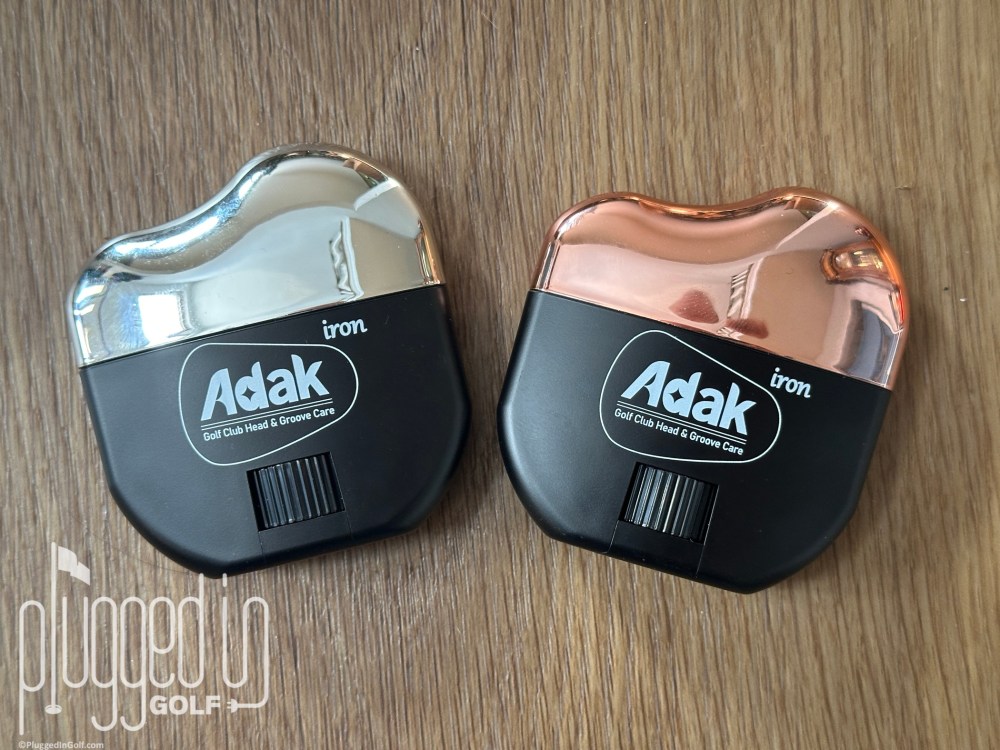
But wedges, like everything else in golf, are expensive. A fresh set of short game tools is likely to cost $500 or more. So, to help you play your best golf while saving a few bucks, we put a groove sharpener to the test to find out if it can make your old wedges play like new.
The Myths
Myth #1 – Using a groove sharpener can increase spin on a new wedge
Myth #2 – Using a groove sharpener can increase spin on an old wedge
Myth #3 – Using a groove sharpener can improve accuracy on a new wedge
Myth #4 – Using a groove sharpener can improve accuracy on a old wedge
Myth #5 – Using a groove sharpener can improve consistency on a new wedge
Myth #6 – Using a groove sharpener can improve consistency on a old wedge
These six myths were chosen based on ADAK’s claims of “increasing backspin for better control and accuracy.” ADAK claims that their testing with the Korea Institute of Golf Science showed increases of up to 3,800 RPM after using ADAK. That’s an incredibly high bar given that Tour players hit full wedge shots with around 10,000 RPM.
How We Tested
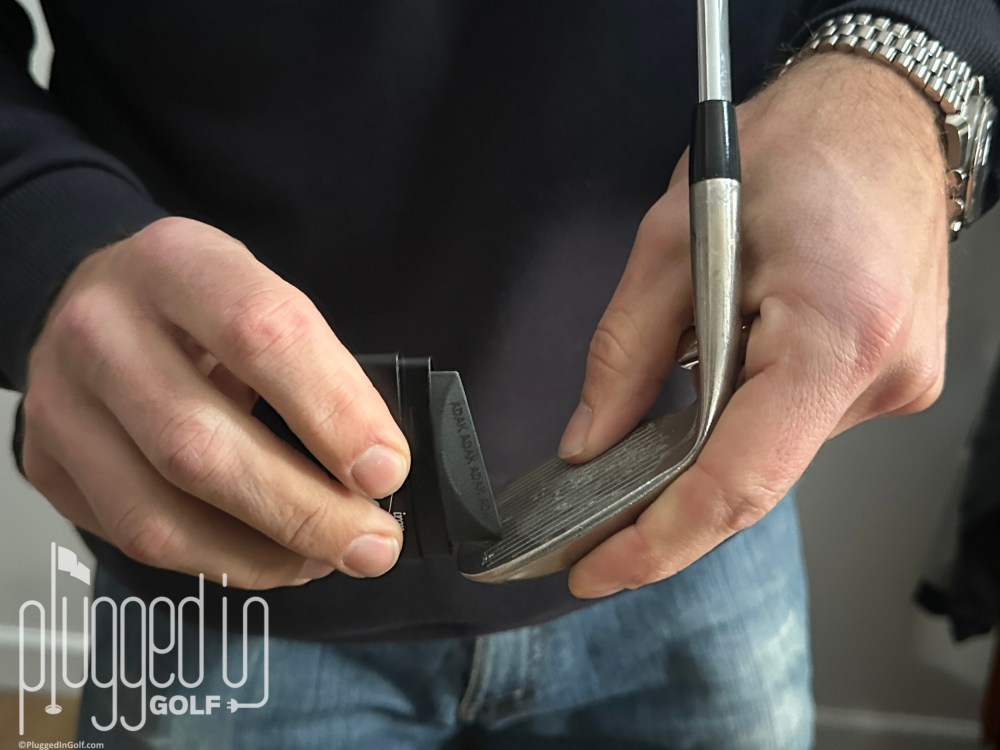
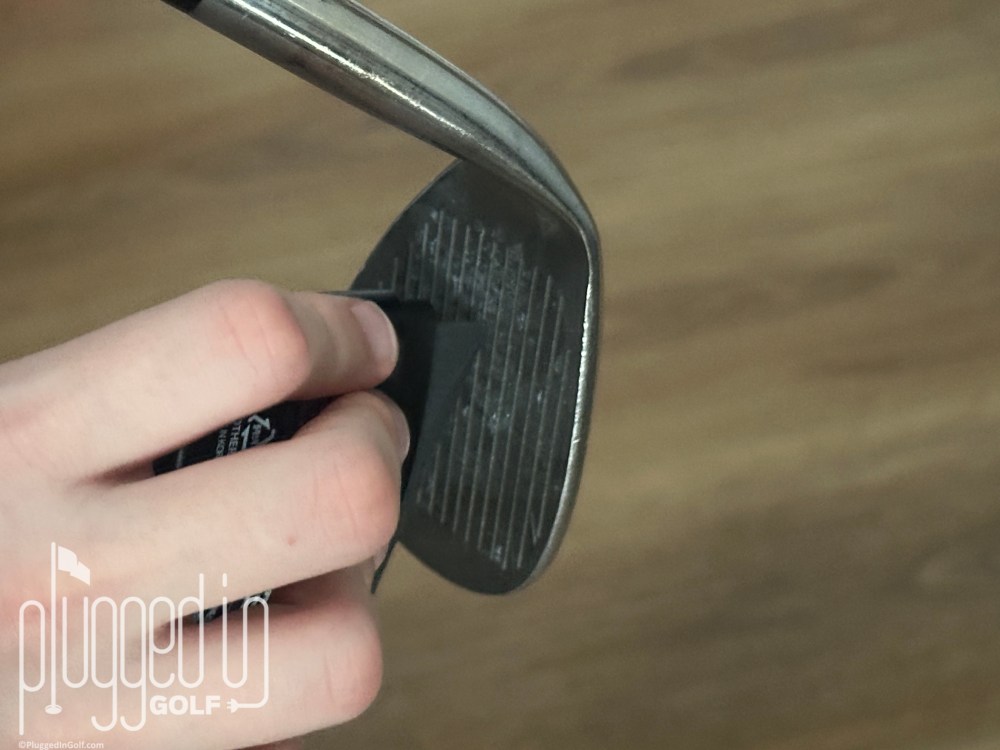
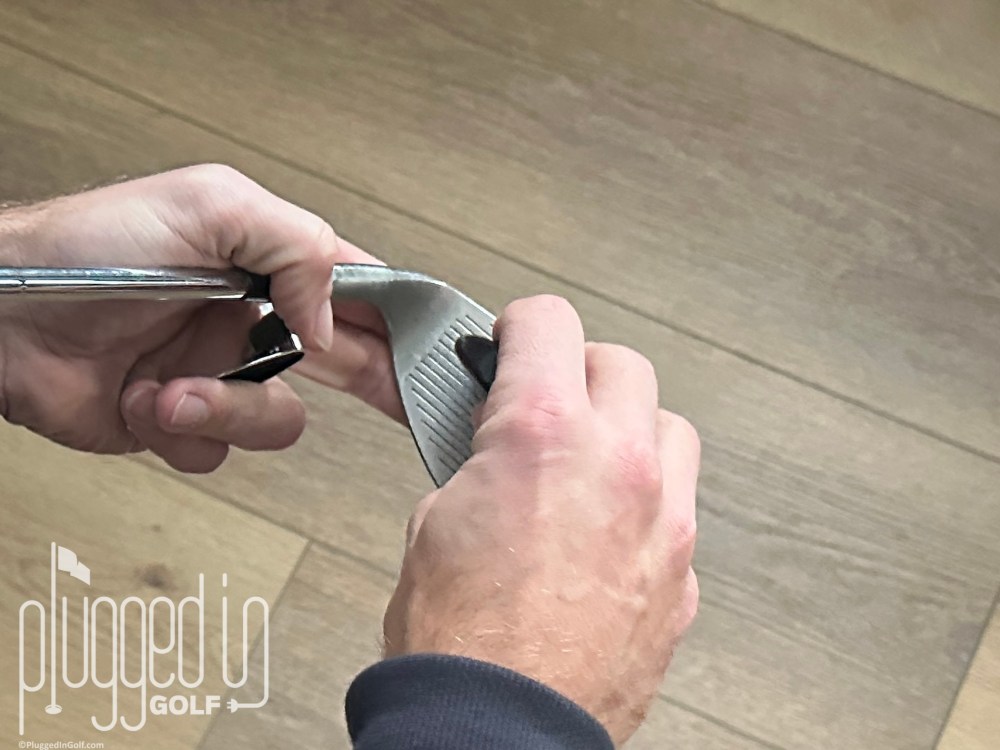
For this myth, we started with one brand new wedge and one wedge that had seen over two years of regular use. The old wedge was cleaned prior to testing but the grooves were not sharpened. Our group of six players hit twenty wedges shots – ten with each wedge. Then we put the groove sharpener to work. We used the ADAK Groove Sharpener [find it HERE], made five hard passes through each groove, then cleaned the face with water and a towel. Finally, each player repeated the twenty wedge shots.
All shots were measured by Trackman and all testing was done at and with the help of Club Champion.

Results
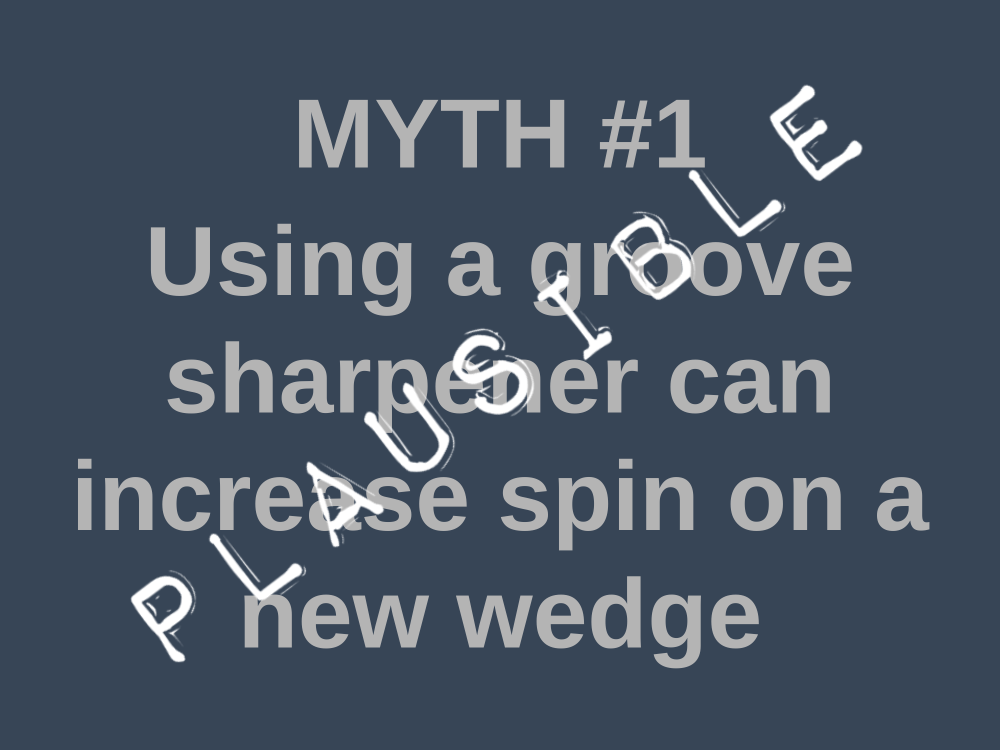
We did not expect to see the groove sharpener improve spin on a brand new wedge, but that is what the data showed in some cases. For two of our testers, their average spin went up by 10% after sharpening. The other four testers saw a difference of 1% of less, with spin going down in two cases. While the majority of our testers did not see a meaningful change from sharpening a new wedge, the big jumps for two testers make us rate this plausible.
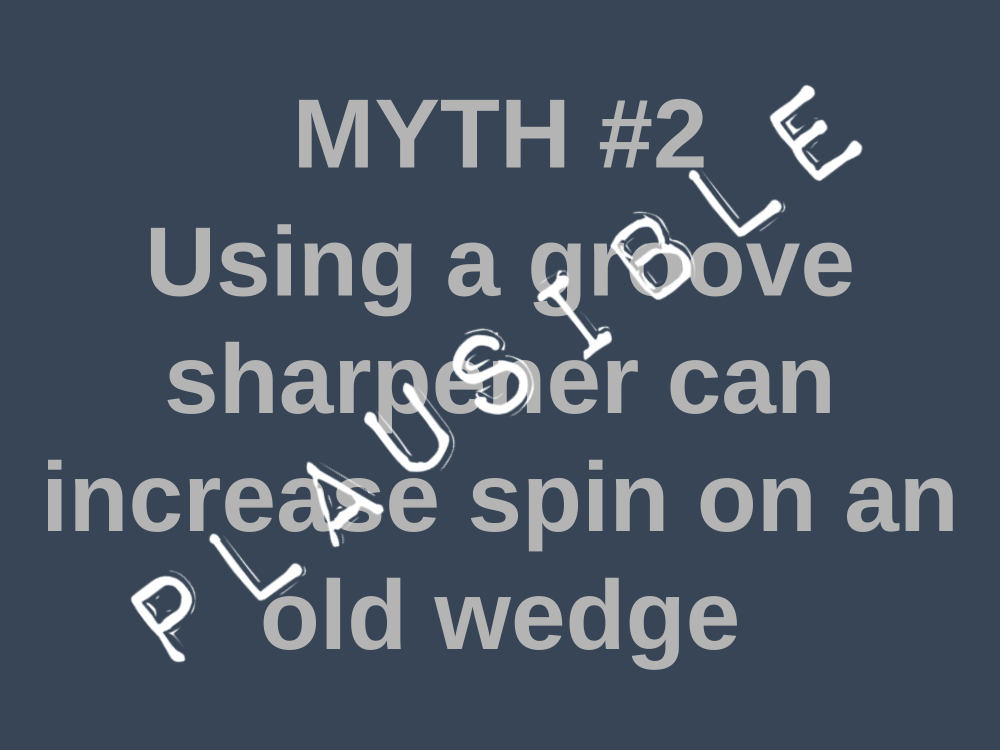
Here’s where we expected to see a big change, but the end result is the same: we rate this myth plausible. Four testers saw a modest change pre and post sharpening: -1%, -3%, +2%, and +4%. One tester had very surprising data, dropping 7% of his spin. The final tester gained 16% with sharpened grooves.
It is worth noting that even our standout tester who gained 16% more spin came up well short of the 3,800 RPM gain claimed by ADAK.
We saw almost exactly equal dispersion patterns with our new wedge before and after sharpening the grooves. We looked at dispersion both left-to-right and short-to-long. Most of our testers had equal dispersions in both test conditions. The one who was better with the sharpened grooves was balanced by one tester who was better with unsharpened grooves.
This myth eked across the line into “plausible” on the back of superior distance consistency. Across our testers, the left-to-right dispersion was equal with or without sharpened grooves. However, when we looked at dispersion short-to-long, the sharpened grooves produced a tighter shot pattern.

Since we have already discussed accuracy, we evaluated consistency based on three things: spin, launch angle, and landing angle. We looked at both the gap from the highest number to the lowest in each category as well as Trackman’s Consistency number – a measure of standard deviation.
With the new wedge, we did not see any meaningful difference in consistency pre and post sharpening. In almost every instance, the difference between the launch and landing ranges was two degrees or less, and there was no consistent winner. Comparing standard deviations of spin, the difference was typically around 100 RPM.
This final myth, like #4, snuck into “plausible” territory. Looking at spin, the range and standard deviation were smaller with the sharpened grooves but not in a meaningful way. The wins for sharpened grooves were similarly small in launch and landing angle, but they were better in the large majority of cases.
Opportunities for Future Testing
The biggest issue with our testing is that it was conducted indoors on mats, thus negating one of the groove’s primary jobs: channeling away moisture and debris. As we’ve discussed many times, indoor and outdoor testing each have pros and cons. We typically test indoors to preserve a consistent testing environment, and, in this case, it was the only option available because it’s winter in Chicago. That said, this could be an interesting test to repeat outdoors with moisture, grass, and dirt.
Two other ideas stand out as interesting opportunities for future testing. First, does the wedge matter? Does the material or the design of the groove make a difference in how “sharpen-able” it is? Second, are there sharpeners that are more effective than others? Also, as always, the data would be more robust if it included more players, more wedges, and a larger number of shots.
Takeaways
While the evidence isn’t overwhelming, it does indicate that there could be value in sharpening your grooves if you have older wedges. At a bare minimum, these are very effective groove cleaning tools, and keeping your grooves free of dirt will help their performance, regardless of how old your wedges are.

He founded Plugged In Golf in 2013 with the goal of helping all golfers play better and enjoy the game more.
Matt lives in the northwest suburbs of Chicago with his wife and two daughters.
- Motocaddy Pro 5000 Rangefinder Review - March 19, 2026
- SeeMore SKx Putter Review - March 17, 2026
- 2026 Wilson Staff Model CB Irons Review - March 16, 2026






17 Comments
Would the sharpener damage the grooves in a way that it would impact wet performance? I know the Cleveland RTZ wedges performed well in moisture testing, and Ping wedges have a coating to help with wet conditions, I would be concerned that the groove sharpener could impact these things on wedges.
What if someone uses the sharpener wrong, can it make the grooves worse?
Hopp,
I don’t have any data on that, but my strong suspicion is no. While groove geometry matters to a point, I think generally bigger is better. Also, the groove sharpener is not like, say, a pencil sharpener, chewing through loads of material, it’s making a fine change to the groove.
Best,
Matt
Got the Groovex Pro sharpener and it has really worked well to recontour the grooves on the raw steel forged wedges that I use. It has definitely extended the life of my wedges significantly. Spin improvement is noticeable on course.
Question- were both wedges the same model and loft?
If they were- did old resharpened wedge perform equal to the new wedge?
That is the question ALL of us want to know!
If you resharpen groves in an old wedge will it perform like a new one?
Otherwise what’s the point?
The two wedges were not the same model.
-Matt
Are groove sharpeners ever recommended for irons other than wedges?
Mark,
You can use them to clean/sharpen iron grooves as well.
-Matt
I had bought a groove sharpener years ago that came with 6 or 7 different bits from “V” shaped to “U” shaped. Apparently grooves would vary between club brands. I never really noticed a difference (except in my head) but I didn’t have a launch monitor either. I agree that more testing needs to be done on real course conditions. Good article. Thanks.
when I researched my clubs I found that long irons, mid irons, short irons and wedges had different groove shapes, widths and depths. so different tools were required to sharpen/shape the grooves.
that being said the task is a refining a factory set; to reshape a “V” groove to a “U” groove will be a long and tedious task with a complete reversal a near impossiblity. in short the goal is a touch up job.
your last comment would be an interesting test. Is there a meaningful difference in performance for my currently dirty wedges vs actually cleaning them?
Greg,
We haven’t tested dirt yet, but we did test with water: https://pluggedingolf.com/can-a-wet-club-face-ruin-your-approach-golf-myths-unplugged/
-Matt
I have heard anecdotal reports of groove sharpeners causing the wedge to become non-conforming in many instances. Myth or………..?
Ken,
It’s possible, but it seems unlikely to me unless you used a metric of elbow grease.
Best,
Matt
I have used a groove sharpener on all of my irons. For $6.99 the Bulex Golf Club Groove Sharpener (See Amazon) works fine. Repeated passes through the grooves removed the slightest amount of metal dust. After the groove sharpening I did not see a dramatic improvement in ball backspin, but maybe I believe that I did from a placebo effect. If you love your old and worn face golf clubs it’d be a worthy experiment to use the groove sharpener. After you grind out the grooves and the old clubs still don’t perform like they did when new, admit that it’s time to buy a new set.
I can see where sharpening wouldnt work on new wedge but I have used on 2 year old wedges and found modest increase in spin and control.
Recently I received an old well used Nortwestern 60 degree sand wedge as a joke. The groves were gouged and in rough shape so I bought a $7 grove tool and cleaned it up. It actually looked and felt sharp to the touch. It tested it an indoor commercial golf simulator and it actually worked well. The balls stopped little to no carry on shots of 25 to 45 yards. Not the prettiest club but it worked. I’m not sure if I’d try sharpening a newer club of value but it seems to have the desired result.
I had read previously that using a groove sharpener could render your wedge non-conforming.