

50 Words or Less
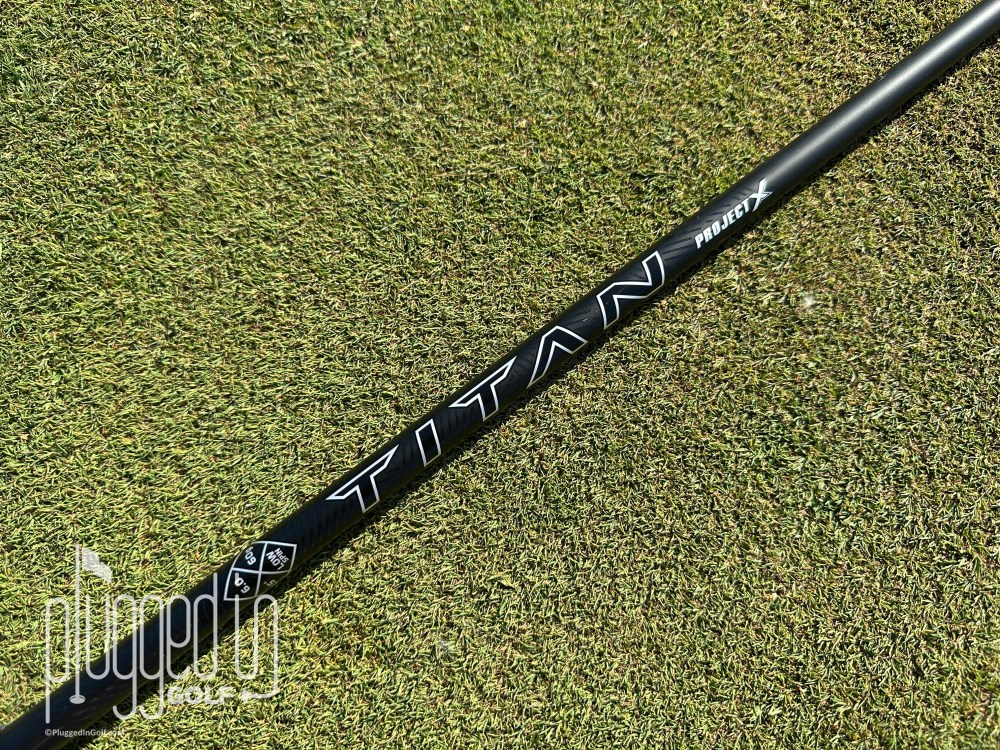
The Project X Titan shaft carries forward the HZRDUS legacy of low launch and low spin. Tight dispersion. Very stout feel which can lead some players to overswing if not well fit.
Introduction
After five extremely successful iterations, Project X has retired the HZRDUS franchise. In its place is the new Titan line. Those are incredibly big boots to fill. HZRDUS has been a consistent winner on Tour in addition to routinely being chosen as a stock shaft in some of the best drivers. Can the Project X Titan carry on the low launch, low spin legacy? I tested it to find out.
Looks
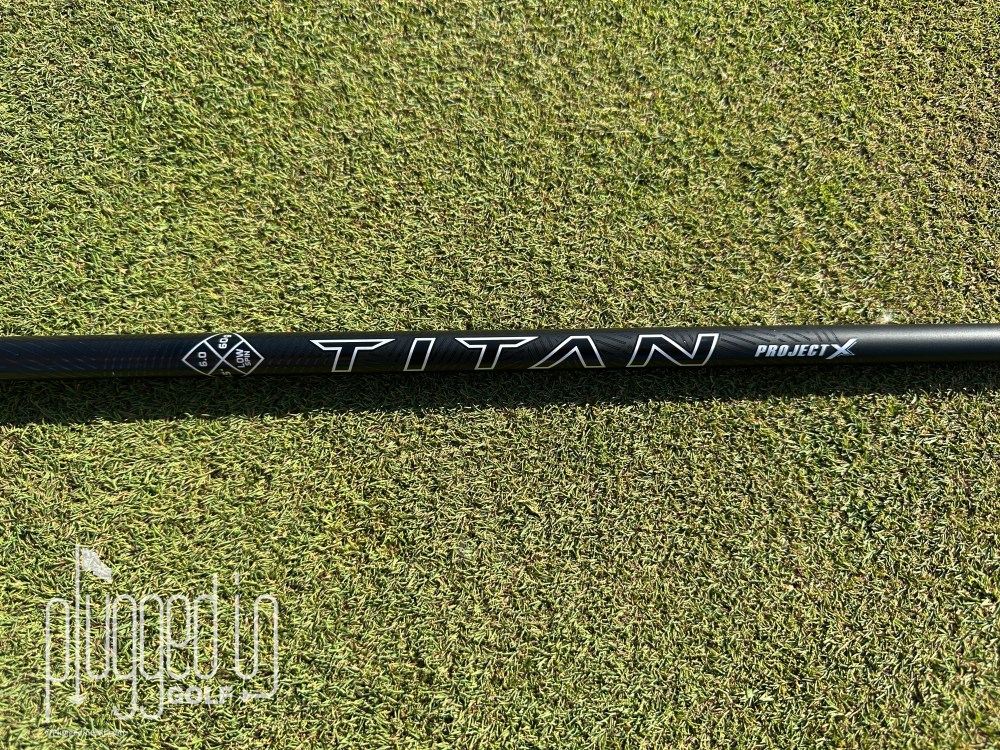
You’d be excused for not realizing that the Project X Titan is a new offering as it carries forward the visual signature of the HZRDUS line: the specs placard. This version is purely black and white, so it’s not as hazmat coded as the multicolored version on the 4th Gen HZRDUS Black [review HERE].
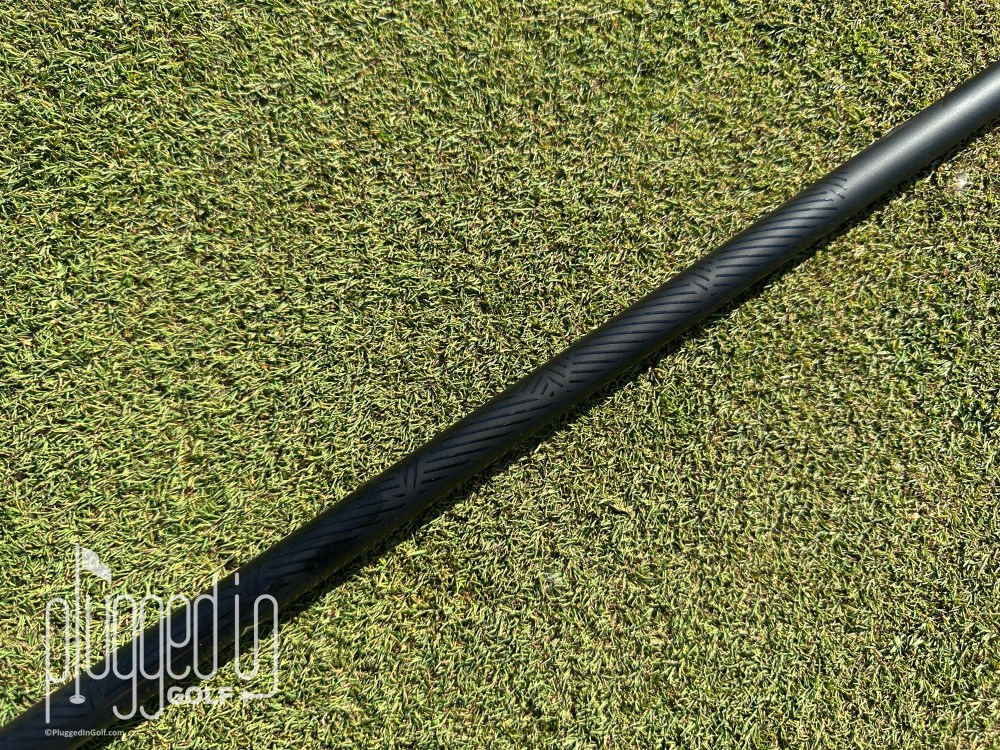
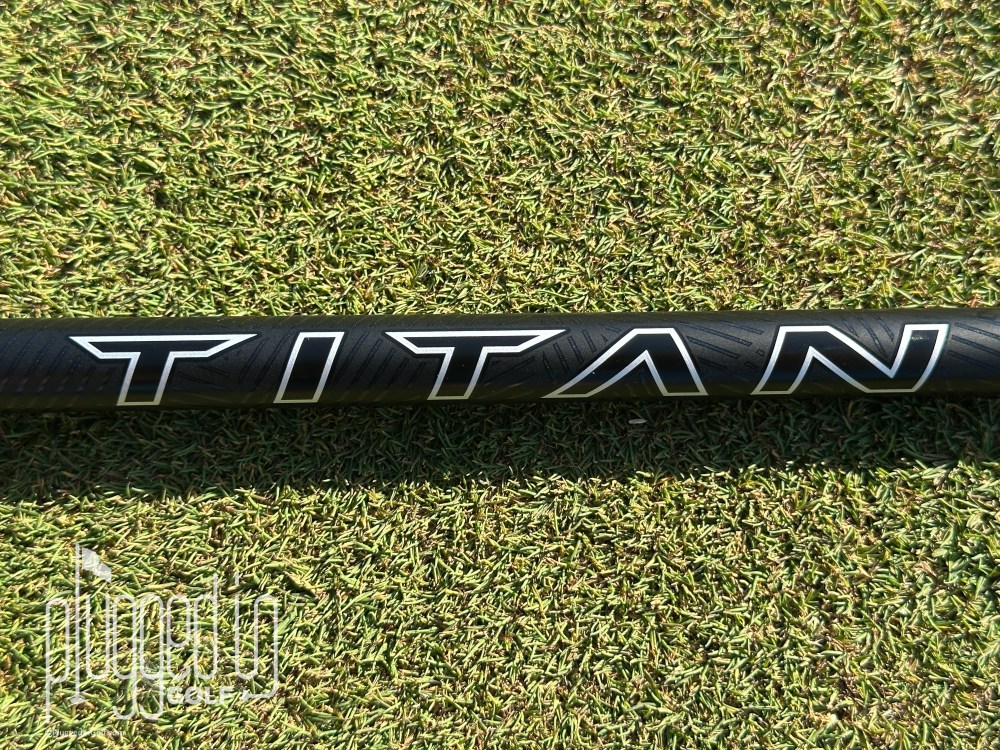
In fact, the entire shaft eschews colors of all kinds. This shaft is black with branding in white/silver and some black-on-black graphics. If you want eye-catching colors and designs, this is not for you. [See Price / Buy]
Feel
I tested the Project X Titan in both the 6.0 and 6.5 flexes. Starting with the 6.0, I was pleasantly surprised at how good it felt. I felt a whisper of a kick in the lower third of the shaft but still got tremendous stability on mishits. As I warmed up, that whisper became a little more louder, and I even had a couple all-out swings where I felt that I lost the shaft a bit.
Feeling rather pleased with myself, I loaded up the Project X Titan 6.5. My ego was promptly deflated. I felt zero action. The Titan pushed me to swing harder. Interestingly, the feel of impact wasn’t harsh, it felt really clean and clear. I simply couldn’t get the shaft to “activate.”
Overall, I think the Project X Titan feels great when it’s fit perfectly or even a hair soft. For me, going too stiff led to over-swinging and poor results.
Performance
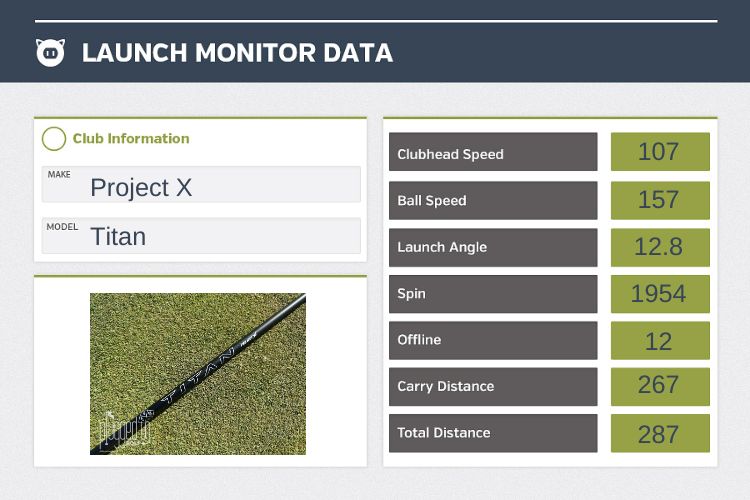
The headline feature of the Project X Titan, common to both the 6.0 and 6.5, is the low launch and spin. Per Project X, the Titan has “progressively stiffer mid and tip sections” that promote this lower ball flight. With both shafts, my best shots flew below my normal trajectory with limited spin and ample run out. For high spin or high launch players looking for a sturdier ball flight in the wind, Project X continues to offer one of the best options.
Turning to dispersion and consistency, I’m going to ignore what happened with the 6.5. I brought it to the range several times, and it was just too much for me. I’m sure at some point it became a mental thing, but I was overswinging it like crazy and making a lot of poor contact. Project X’s website says the Titan gives you “the confidence to swing faster.” This shaft is capable of handling the most aggressive swings, but for me, when it’s too stiff, it makes those overly aggressive swings too common.
That brings me to the Project X Titan in 6.0, which performed really well. The dispersion on stock shots was excellent. As I often say, this is a shaft that gives you exactly what you deserve. When I made a draw swing, I got a little draw. I could create a fade. But I never had to worry about the Titan generating a hook or slice on a good swing. The one area where it gave me more than I deserved was on mishits: it’s incredibly stable and kept off-center strikes on target.
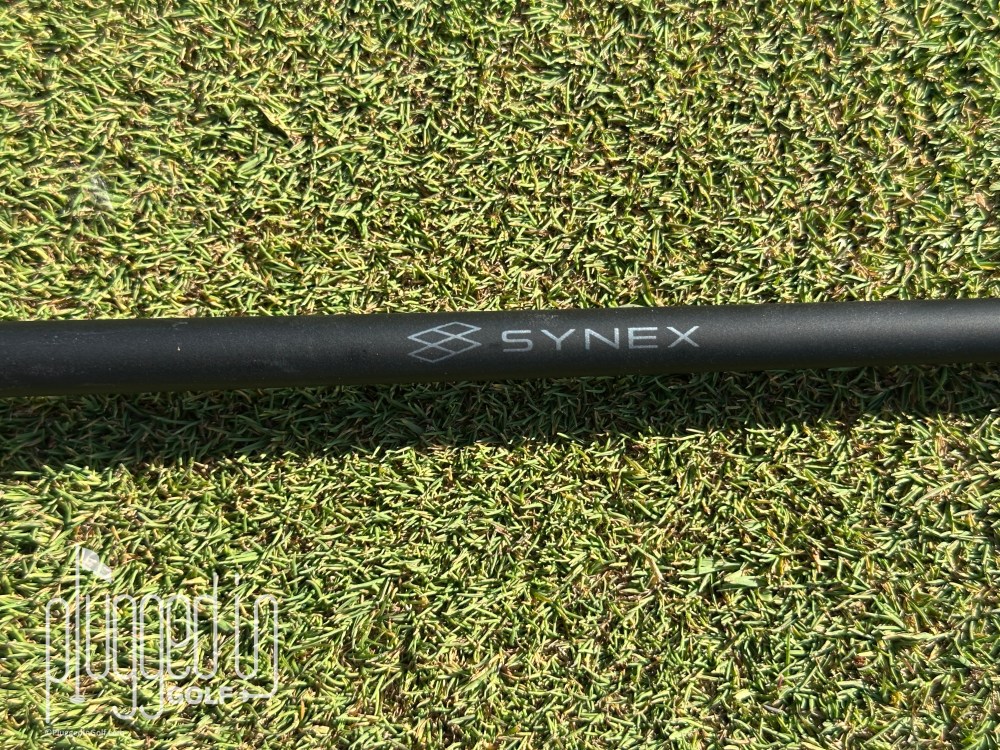
Project X calls the Titan a “reinvention,” alluding to the numerous generations of HZRDUS shafts that preceded it. For those interested in the tech story, the Titan’s two signature developments are an “Advanced EI Curve Design” and Synex Technology. The latter is a “multi-axial carbon fiber matrix” built to prevent “ovalizing” and improve energy transfer, similar to UST Mamiya’s LIN-Q PowerCore [review HERE]. The profile of the Titan has a “more elastic handle section” to give players more feel without sacrificing tip stability.
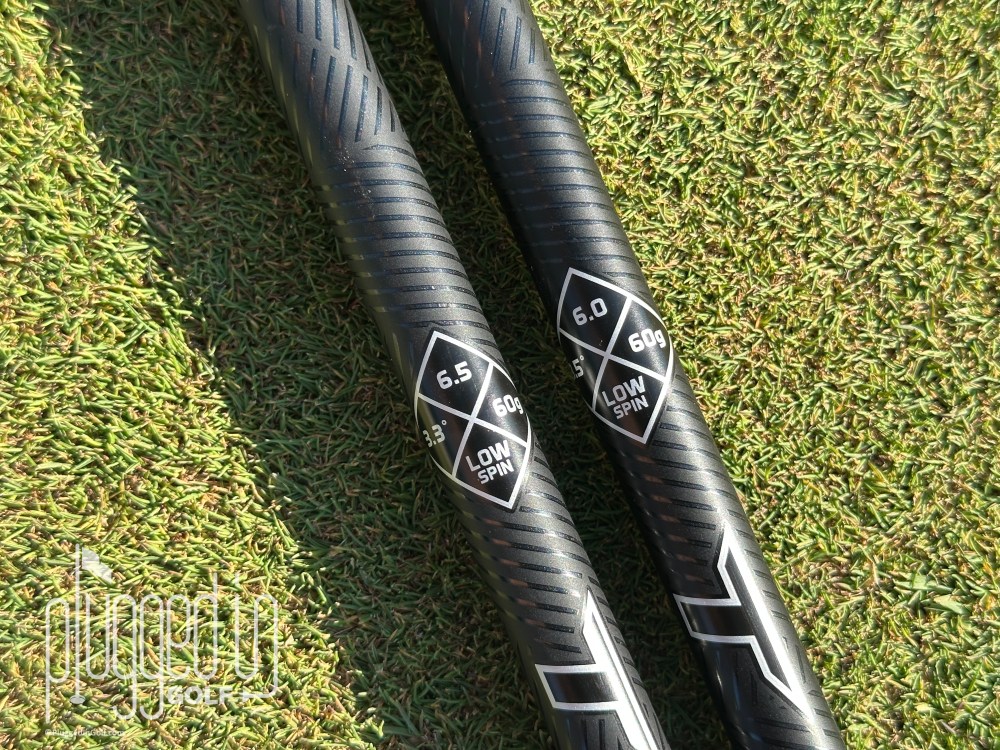
For those interested in the “stock vs. aftermarket” debate, I had the opportunity to test both versions of the Project X Titan. I was fit for the Titan Black in 6.5 for my Titleist GTS2 driver [more on that HERE]. It’s visually identical to the aftermarket version. During the swing, however, the stock 6.5 is clearly different – specifically, much softer – than the aftermarket 6.5. I have no insider knowledge about this; I can only report that the stock 6.5 was very playable for me, the aftermarket 6.5 was not.
Read our Golf Myths Unplugged on stock vs. aftermarket shafts HERE
The Project X Titan shaft is offered in four flexes: 5.5, 6.0, 6.5, and TX. In the 5.5 flex, roughly equivalent to regular, Project X offers 60 and 70 gram versions. For all the other flexes, the Project X Titan is available in 60, 70, and 80 gram weight classes. [See Price / Buy]
Conclusion
The name is different but the story is the same: the Project X Titan provides low launch, low spin, and tight dispersion. This is a great choice for aggressive swingers who want to feel a shaft keep up with them. Just make sure to get fit for the right flex so you get the benefits of this stout design without the costs. [See Price / Buy]
You can only evolve so many times. Then you have to reinvent. TITAN Black is built specifically to meet the demands of today’s faster, more aggressive swings. This isn't just an evolution; it’s a complete reinvention of shaft stability and feel.

He founded Plugged In Golf in 2013 with the goal of helping all golfers play better and enjoy the game more.
Matt lives in the northwest suburbs of Chicago with his wife and two daughters.
- Mitsubishi TENSEI 1K Pro Orange w/RIP+ Technology Shaft Review - August 28, 2026
- Linkslite Explorer Golf Bag Review - August 27, 2026
- Shogun FLEX Review - August 24, 2026





12 Comments
As the VP of R&D for Project X, I can confirm that the Aftermarket part and the part in the Titleist are exactly the same shaft made in exactly the same factory. There is no design or materials difference.
On the Titleist shaft menu , the Titan Black shafts listed are stock or aftermarket ?
For a swing speed of 95 mph , which one would you recommend?
See above.
– Meeks
Andrew,
The Titan Black is a stock offering from Titleist. I always recommend a fitting before buying a shaft or club.
Best,
Matt
I was fitted by Titliest for a Titan 6.0..swing speed 97mph..felt great but tried it again a week later and results were not so consistent.
SecretGiveawayH50
Thanks for the review. I’ve been eager to hear about this one. Sounds like a replacement for HazBlack or T1100.
Your definitely different experiences between Titleist fitting Titan and Review shaft Titan are perplexing, given the comment from Don. I don’t know how you guys set up review shafts, but could your builder inadvertently have tipped the Review shaft an inch or more, and that explains the noticeable feel differences?
#SecretGiveawayH50
George,
The builder is me, so there was nothing inadvertent. :)
I never tip driver shafts for reviews, so that’s not the issue here.
Best,
Matt
Really interested in trying this out as a replacement for my HZRDUS Black. Given Don Brown’s comment about the shafts being exactly the same for OEM vs aftermarket, is there anything you’ve seen as a long-time club reviewer that might explain the differences in the two shafts?
I don’t know how much, if at all, of a “break-in” period this shaft might have, but could the Titleist fitting shaft have been hit many, many more times and thusly be a bit more “broken in?” Just grasping at straws here.
#SecretGiveawayH50
Marshall,
I have no reason not to believe Don, so my best explanation is just variance/tolerances.
Best,
Matt
One thing that perplexes me with Project X is their shaft flex labelling. Typically they list 6.0 as their Stiff flex, and 5.5 as their Regular flex. Maybe I’m wrong, but it seems that most shaft companies listed a full flex difference as being 10 cpm’s apart. Thus, if 6.0 is Stiff, then 5.0 would be Regular, and 5.5 would be a stout regular or in between flexes, an R/S.
#SecretGiveawayH50
How can you tell the difference between the Titleist version versus the aftermarket version? I’ve heard the 1K RIP white is a stock version and the aftermarket is the Pro 1K white. Also the Taylormade stock Ventus are nonvelocore.
Art,
Are you asking how to tell them apart visually? From that perspective, there is no difference. Also, per Project X, there is no difference, period. I felt a difference in the shafts I had, but that can reasonably be explained by variance from shaft to shaft.
Best,
Matt