
“What Is a Wedge?”
At first blush, that may seem like a silly question. However, as you try to work toward a definition of a wedge, you realize it’s not so simple. That made it a perfect jumping off point for an in-depth discussion with one of golf’s greatest wedge experts, Terry Koehler, founder of Edison Wedges.
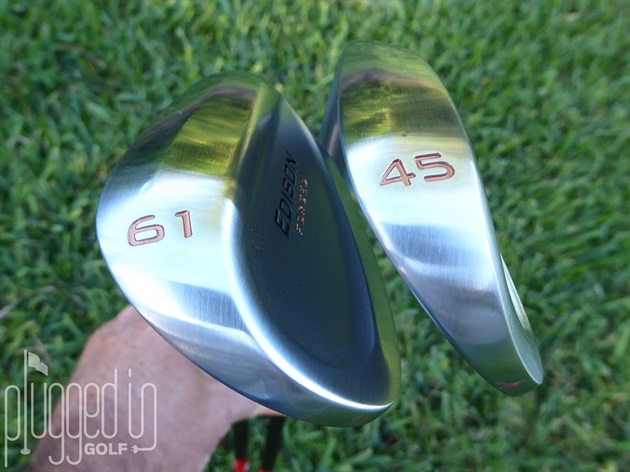
Matt Saternus: We’re trying to answer the question, “What is a wedge?” I’m going to suggest a few definitions, and I’d like you to tell me what you think is good about them and where you think they fall short. Attempt #1: A wedge is a high-lofted golf club.
Terry Koehler: Well, Matt, how are we going to define “high-lofted”? The iron models on the market today feature “P-clubs” as low as 42 degrees of loft. It wasn’t all that long ago, that a 42 degree club would have had an “8” on the bottom, so just calling that a “wedge” certainly doesn’t make it one.
Matt: If we picked a particular loft, would that make this a better definition? For example, any club with a loft greater than 40 degrees? 45? 50?
Terry: Well, I think this just moves the conversation to the other possible questions about what defines a wedge. But I’ve seen a couple of “all fairway wood” set of clubs that go all the way to the “25 wood” with traditional sand wedge loft of 55 to 56 degrees? Are those still “wedges”?
Matt: Attempt #2: A wedge is a club you use when you’re close to the green.
Terry: Usually . . . maybe . . . but many times, around the green you find yourself chipping with a 7-iron or 8-iron, depending on the shot at hand and how much you want it to roll out after it lands. And chipping with your hybrid or 4-wood adds another shot to your arsenal. That certainly doesn’t make it a wedge.
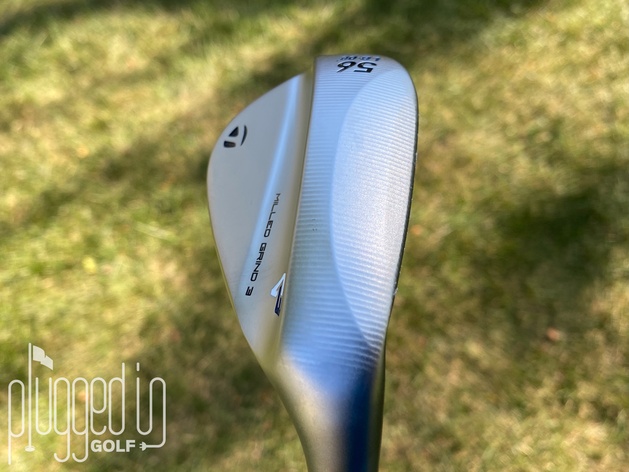
Matt: Attempt #3: A wedge is a club with bounce on the sole or certain types of sole grinds.
Terry: I think this is getting closer to defining what a “wedge” really is. I often have tried to explain to beginners to think of the “wedge” as exactly that – you are trying to “wedge” the club between the earth and the ball, so that the loft makes the ball go up and the bounce keeps the club from digging . . . if you do it right, that is.
Matt: If we were to use this definition, where would we draw the line? Because the vast majority of irons have some amount of bounce and are intended for use with a slightly descending strike.
Terry: Therein lies the challenge with this definition . . .
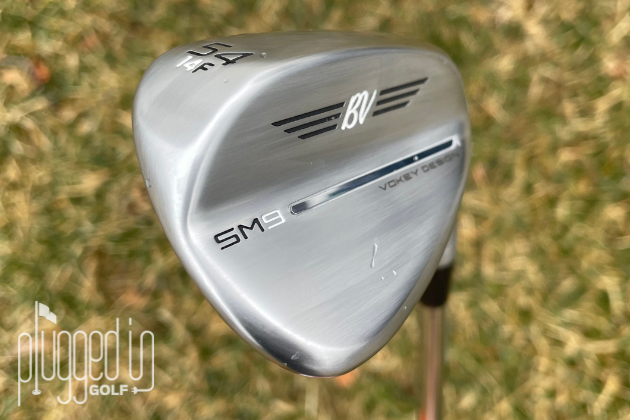
Matt: Attempt #4: A wedge is a club that looks like a wedge. We know what that means – a skinny top of the blade, no cavity back, heavy sole, your traditional TItleist or Cleveland wedge.
Terry: So that would mean that any high-lofted club that doesn’t look like that really isn’t a “wedge”? What about these so-called “game improvement” specialty wedges with a big sole and deep cavity?. Or those clubs of lofts higher than the 9-iron that match the other irons? Does that mean neither of these are really “wedges”?
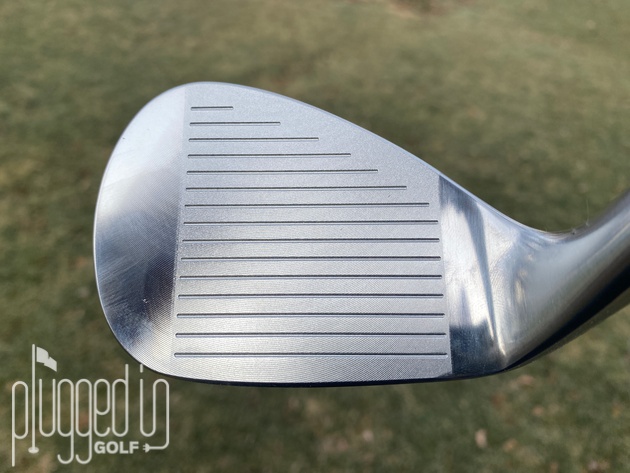
Matt: Attempt #5: A wedge is a club with aggressive grooves cut into the face to provide more spin and more consistent spin, even in the rough or in wet conditions.
Terry: The USGA regulates the groove geometry very tightly and most irons will push those groove limits throughout the set. While I do believe you should modify the groove pattern a bit into the higher lofts, those grooves are really not any more “aggressive” than any other iron.
And it is widely believed that the grooves are what imparts the spin, but I’ve seen robotic testing prove that – on a dry ball and clubface – the total absence of grooves only reduces spin by 15-20 percent. The “spin formula” is very complex and includes clubhead speed, angle of attack and impact conditions, i.e. cleanliness of the ball/club contact. But modern ‘tour design’ wedges and those claiming to be “game improvement” all have the majority of the clubhead mass at the very bottom, which actually is not an efficient placement of mass to optimize spin.
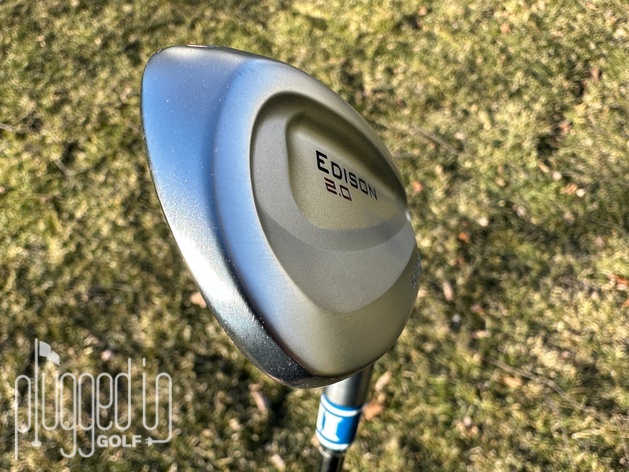
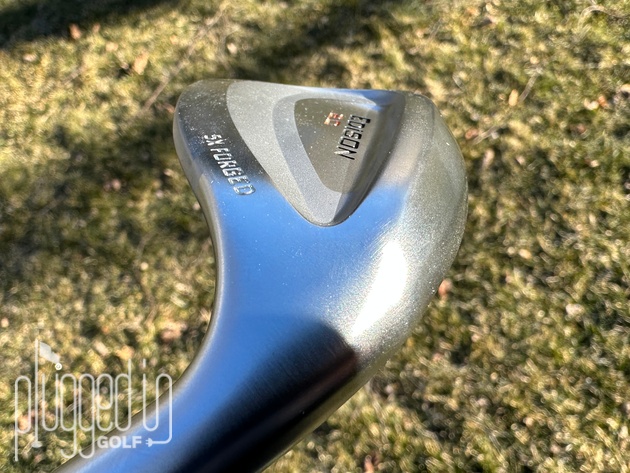
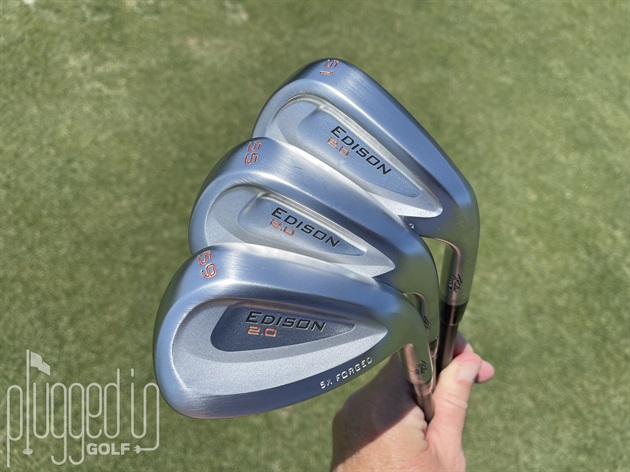
What I did with the EDISON 2.0 wedges – as I have throughout my wedge design career of 30-plus years – is to position much more as much mass as possible above the likely point of impact to optimize gear effect to enhance spin. Essentially the opposite of what is going on in irons, hybrids, fairways and drivers, where the “holy grail” is high launch and low spin. They get that by concentrating mass as low in the club as possible . . . which is where the mass is concentrated in most wedges.
Matt: So none of the five criteria alone make a good definition; do we need to layer them? How would you use what we’ve discussed so far – or anything else you have in mind – to define a wedge?
Terry: That is really a tough question for sure, as this dialogue is proving. Maybe what defines a “wedge” is some combination of these definitions . . .
“A wedge is a higher lofted club, say i.e. 45-48 degrees or more, which has a sole with a definite measured ‘bounce’ angle that reduces the club’s tendency to dig, but rather to ‘reject’ from the turf to some degree, and which club allows a wide measure of shotmaking versatility when the golfer finds himself/herself within prime scoring range, i.e. less than a full swing 9-iron shot.”
To that definition, “wedges” on the market today can be found in three basic configurations:
- “Tour Design” – The traditional shaping of a ‘wedge’ that puts the majority of mass along the bottom of the clubhead, and relative thin cross-sectional thickness in the upper 2/3 of the clubhead. Usually a single piece forging or casting, but might feature some multi-material construction to help manage CG location.
- “Game Improvement” – Can have a reasonably traditional face profile and offset, but generally a much wider sole and thinner face to compensate, with some measure of perimeter weighting.
- “Set Match” – Those higher lofted clubs that are designed to closely match the technology and cosmetics of the lower-lofted irons of the same make/model.
Matt: Those three categories of wedges launch us into a new direction. What do you see as the primary advantages and disadvantages of each of those categories, with respect to the recreational golfer?
Terry: Now, we’re getting to the meat of the matter. Each of those categories has its strengths and weaknesses . . .
- “Tour design” wedges have dominated the marketplace for years, because that’s about all there were to choose from. And the store shelves are still loaded with them. The problem is that these clubs are designed around the exquisite skills and talents of the game’s elite players. And they spend thousands of hours with them to learn hundreds of different shots. These players cannot afford for their wedge performance dynamics to change from year to year, as they cannot afford to keep learning scoring skills over and over and over again. So, while 98% of golfers will not try to game the same tour blade irons the pros use, but they are trying to play the same wedges. What they don’t know is that ‘tour design’ wedges are less forgiving than even tour blade irons.
- There is a category of wedges now that feature very wide soles and big, deep cavities in the back, and they are sold as “game improvement” designs. But to me, they are really ‘one trick ponies”, designed to help you get out of the bunker. Period. Those big soles do not allow optimum playability from tighter lies, and the thin faces cause a very sporadic smash factor as impact is made around the face.
- I am a firm believer that extending the matching set of irons through the traditional wedge lofts is a bad idea, because what works great at 27-29 degrees of loft (the 6- or 7-iron) doesn’t produce desirable shot dynamics at higher lofts, no more than it can produce proper dynamics at lower lofts. People don’t realize stop to think that their 6-iron is as far in loft from their “P-club” than it is from their driver. I’m pretty sure no one ever has said, “I hit my 6-iron great; can you make me a driver that looks just like it?”
I guess that brings us to shameless self-promotion, but what I’ve been pursuing for over thirty years is to cast aside pre-conceived notions of what a “wedge” is, start with a clean slate and design a range of high-lofted scoring clubs that combine versatility to a variety of turf conditions and consistency of impact dynamics across a wider area of the face than can be achieved with any of those three approaches to “wedges”. Maybe it’s time to create a new word . . . like we did with “hybrids”?
What I’ve learned from hundreds of robot tests of all kinds of wedges and thousands of golfer interactions over those three decades is that it requires face thickness directly behind the point of impact to deliver that consistency. I began to move weight up in the clubhead as far back as the early 1990s with my Reid Lockhart wedges. I continued to move more and more mass up in the clubhead through the EIDOLON wedges of the early 2000s and then added progressive weighting to optimize mass distribution through the range of lofts with my SCOR designs and the Ben Hogan TK15 wedges. All of those concepts have been copied by the major brands.
With the EDISON 2.0 [review HERE], I’ve pushed all those design goals to a new height and believe I’m very close to perfection for high-loft scoring clubs . . . wedges. What you want from your higher lofted scoring clubs is consistent trajectory, spin and carry distance through a wide range of clubhead speeds, from greenside chip of only a few miles per hour to full swing shots – regardless of what that range is for you. That consistency of impact dynamics is essential for you to refine your shotmaking. If the wedge has hot spots and dead spots – which all conventional almost all golf clubs do have – that becomes an impossible task.
You’ve been testing wedges for as long time, Matt, and you’re seeing this. All the major wedge brands are now putting a bit more mass in the top of the club. They all know that it works, but none exhibit a face thickness above the 5th or 6th groove that is anywhere close to the EDISON 2.0 wedges. In fact, none are even as thick as my Reid Lockhart wedges were in the 1990s. I believe it’s because they are held back by their Tour professionals, who don’t want big changes in their wedge dynamics, because they cannot afford to constantly re-learn their short-range shotmaking skills.
Matt: Admittedly we’re talking about a small portion of the golfing population, but where does that leave the low handicap player who has a well-established short game? Do they benefit from the high CG wedge also, or are they better off sticking with the Tour-style wedges they’ve built their game around?
Terry: I can’t imagine a player of any skill level who wouldn’t like to tighten their distance dispersion in their wedge game. And that’s what the EDISON 2.0 wedges do. The more refined your short game skills, the longer adjustment period you might have, but you’ve seen this yourself – the technology just works better.
Matt: Given everything we’ve discussed here, what is your advice for recreational golfers when they’re building their set, particularly the high lofted clubs?
Terry: I call it golf “by the numbers”. We all have a strength profile that determines how far we can hit our longest approach club reliably, whether that is a fairway wood or hybrid or long iron. Ideally, you will build your set to give you incremental distance differentials from that club down to your highest lofted wedge. And I think that club is a personal choice. Mine is a 57, some like to have that club be as high lofted as 62 to 64 degrees.
But ideally, you want tighter distance differences between clubs as you get closer to the flag. After all, a five-iron shot that is 30-40 feet long or short isn’t that bad [Matt’s note: a 200 yard approach hit to 30 feet would make you #3 on the PGA Tour], but a wedge shot that is that far long or short is a lost opportunity to score.

He founded Plugged In Golf in 2013 with the goal of helping all golfers play better and enjoy the game more.
Matt lives in the northwest suburbs of Chicago with his wife and two daughters.
- Dixie Red Hills Golf Course Review - October 23, 2026
- Foresight GC2 Launch Monitor Review - October 20, 2026
- Aldila Rogue ∞ CB Shaft Review - October 20, 2026







Join the Conversation | 8 Comments
Really enjoyed this read. I’ve been on the fence about trying the Edison wedges. Shamefully I must admit I ordered the newest Cleveland CBX wedges recently. They are super easy to hit but like Terry said, those “game improvement” wedges limit the versatility around the green. This discussion finally nudged me to go ahead and try one of the Edison 2.0 with the 30 day trial.
-Thanks Matt!
You won’t be sorry, Kevin. I’ve played the Edison 1.0 wedges for a few years now and love them. I’m going to upgrade to the 2.0 version anon.
Matt: fabulous article, full of insights… thanks for getting Terry K to speak with/ contribute on PluggedInGolf.
Thanks!
Am I missing something? This article just seems to end.
It’s great to hear from a manufacturer who teaches and prioritizes education over sales and to get the right club in golfers hands. Thank you for a great article.
Looks like Terry with his Edison 2.0 and Indi Golf are similar, making wedges with more mass up the toe, and offer a wide spread of lofts, and bounces.
Donn,
I know that Indi Golf makes wedges with non-conforming grooves, but I haven’t seen any of their wedges with high CG.
Best,
Matt