
More Tap-Ins, Fewer Knee-Knockers
Jarring a twelve-footer for birdie is one of the better feelings in golf. Knocking in a must-make eight-footer to save par is up there, too. But as much fun as it is to make those midrange putts, the reality is that they aren’t the difference between you and your goal handicap.
The biggest gap between your putting and that of a Tour player is the ability to avoid the dreaded three-putt. Good lag putting isn’t sexy, but it can make the game less stressful and dramatically reduce your scores. For this Golf Myths Unplugged, we tested zero torque putters at long range to see if they’re the key to more tap-ins.
If you want to see how zero torque putters affect your stroke, check out Part 1 HERE
If you’re unclear on what a zero torque putter is, we’ve got you covered. Check out Zero Torque Putters Explained HERE.
The Myths
Myth #1 – Zero torque putters feel lighter than traditional putters
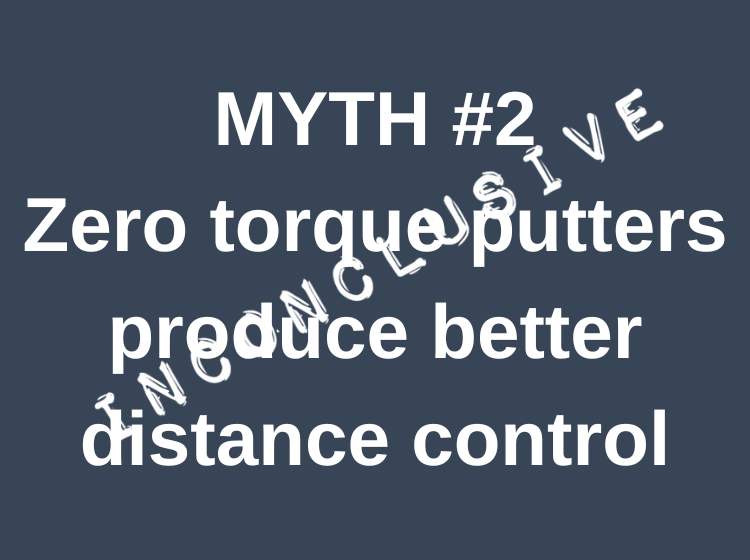
Myth #2 – Zero torque putters produce better distance control

How We Tested
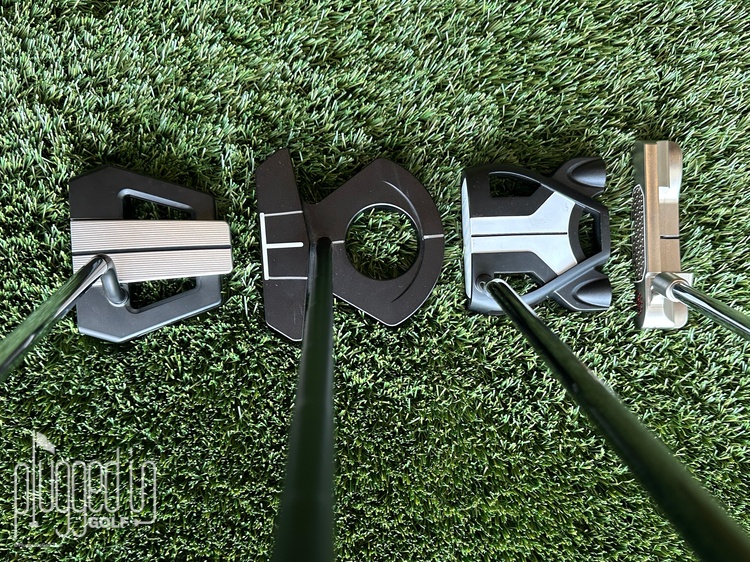
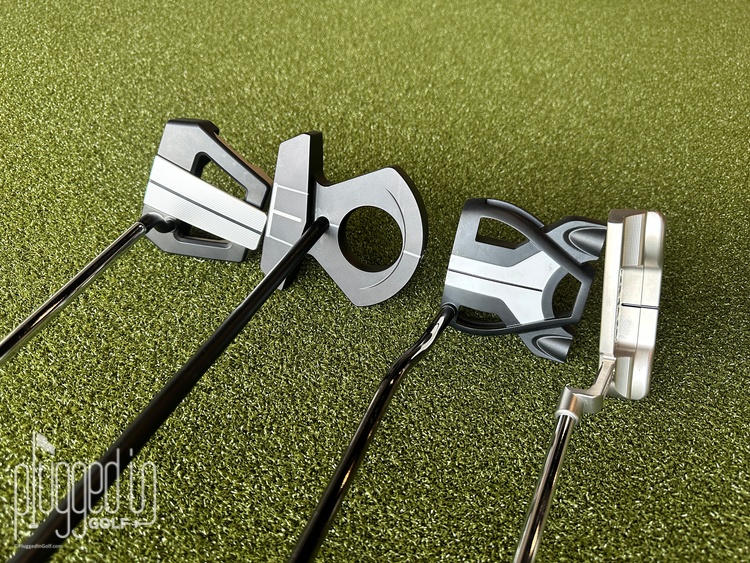
For this test, we brought together five golfers with handicaps ranging from 10 to +2. Each player ran through two series of tests with an array of five putters: a traditional blade, a face balanced mallet, two zero torque putters, and their gamer. The first test involved hitting seven short putts on SAM Puttlab. The second test was hitting five putts from twenty feet. In both tests, we tracked makes and misses. For the longer putt, we measured the distance left to the hole if the putt was not made. Each player tested the putters in a different order.
All testing was done at and with the help of Club Champion.
Results
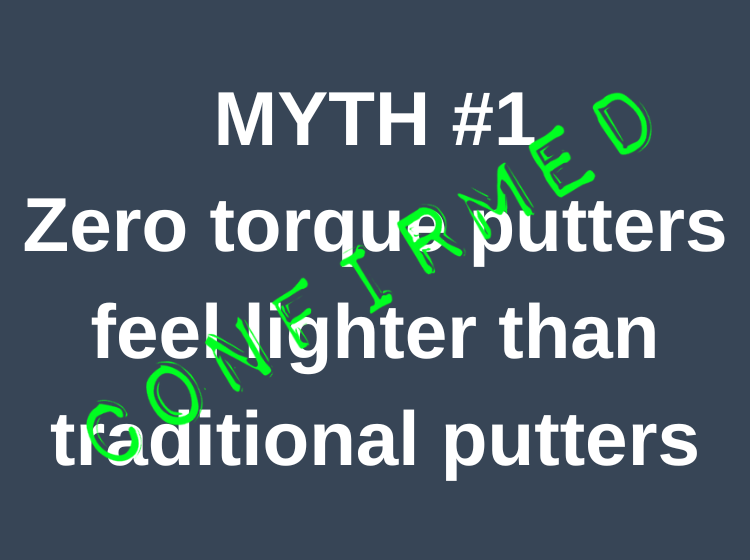
This is the idea that got our zero torque Golf Myths Unplugged started. After reviewing several zero torque putters, I observed that, for a given swing weight, zero torque putters felt much lighter than traditional putters (find a deep dive on swing weight HERE). I reached out to Nick Sherburne and asked, “Am I crazy or do all these zero torque putters feel really light?” His reply was an enthusiastic, “I think so, too!”, which set us off down the path to get some data.
To test this, we took each of the test putters and got the as close in swing weight as we reasonably could. Then, after all the putts were hit, we put each player in front of the rack of putters and asked, “Which one feels the heaviest?” Finally, we told them the swing weight of one putter and asked them to guess the swing weight of the others. This final step was done to find out if the testers thought the putters were similar in swing weight or wildly different.
What allowed us to give this myth an enthusiastic “Confirmed” is that every player selected a traditional putter as the heaviest despite the fact that they were the lightest putters in our test. What’s more, four of the five selected the Anser-style which was by far the lightest putter.
On the second question, most testers guessed that the putters were within a couple swing weight points of each other. If one was rated more than two swing weight points heavier, it was always the Anser-style. This indicates that a lot of what players perceive as weight is actually torque.
You might be asking, “Why are you talking about weight? Isn’t this about eliminating three-putts?” To that I’d say, “Swing weight and feel are inextricably linked with good putting.” If you look at the bags of PGA Tour players, you’ll find lead tape all over their putters. This is done to find that “just right” feel. While Tour players might be more sensitive than most, any golfer would be thrown off if their putter randomly became (or felt) lighter or heavier, so it’s important to understand that zero torque putters will feel lighter than traditional putters.
Within our relatively small test group, we saw a wide range of results when it came to longer putts and zero torque. Two of our testers were lights out with the zero torque putters (ZTP). When they weren’t making the putt, it was finishing within inches of the cup. A third tester produced slightly better distance control with the ZTP than the non-zero torque putters (NZTP).
On the other side of the ledger, tester four was slightly better with the NZTP. He made several putts with the ZTP but also had some long leaves. Our final tester – one who stated he “could never play” a ZTP – showed poor distance control with the ZTPs despite being quite good with them at short range.
It’s important to note, as we did in Part 1 HERE, that the zero torque putters were not competing on a level playing field. Every one of our testers had extensive playing experience with traditional putters and limited or no experience with ZTP. Between this and the mixed results, we rated this myth as “Inconclusive”.
Opportunities for Future Testing
As always, we would love to see these tests replicated with larger sample sizes. We are not advertising these results as the final word but a step toward a better understanding of golf equipment.
For this test, we did as much as possible to normalize the specs between the putters, but there were still substantial differences in head shape. It would be interesting to see if the results would be different if the zero torque and traditional putters looked the same and had similar MOI characteristics. Similarly, we would love to do more experimenting around players’ sensitivity to swing weight and how it’s affected by head shape, toe hang, torque, counter balancing, and more.
Finally, as was mentioned earlier, each tester had more experience with traditional putters. It would be illuminating to try this test again with an equal mix of players who game zero torque and non-zero torque putters.
Takeaways
The idea that zero torque putters feel lighter than traditional putters because golfers are perceiving torque as weight is in the top five most interesting things we’ve discovered in twelve years of Golf Myths Unplugged. It has major implications for putter fitting, whether you’re a professional fitter or just choosing a putter for yourself. If you like a heavy feeling putter, zero torque may not be for you unless you get the swing weight up to extraordinary levels.
At long range – just as we saw at makable distances – zero torque putters are an interesting option, but they are not an automatic fix. They require time, practice, and the right technique to be wielded properly. And, just like any other putter, they need to be fit to the player.

He founded Plugged In Golf in 2013 with the goal of helping all golfers play better and enjoy the game more.
Matt lives in the northwest suburbs of Chicago with his wife and two daughters.
- Odyssey Ai-ONE Square 2 Square Max 1 Putter Review - August 4, 2026
- Cleveland Golf RTZ 2 Wedge Review - August 4, 2026
- Wedge Guys GLP Velvet Grip Review - August 3, 2026





4 Comments
I switched to a lab this year, and it was a LOT to get used to. I think (as you found) the short stuff came pretty easy, and one of their strengths is the confidence to drill sub-10 footers like it’s nothing. However it absolutely took me some time to get used to the longer stuff with distance control.
Between the light feel but large visual face (i have the df2.1 lol) combined with the AL construction it definitely plays tricks on you from a perception of how hard to hit long stuff.
Id say maybe after 3 rounds I had a bit more luck but after a month or so, that distance control which was the hardest thing to adjust to is now SO good with the LAB. Way better than I was with anything prior.
Let’s be honest, this is the hardest part of being a good putter and adjusting for conditions, grain, speed as you play different courses day after day is why its a challenge.
I dont think any type of putter is better or worse for distance control – its all feel. But I will say the LAB removes so much of the other noise when putting by kind of locking your stroke in and barely thinking about your putt being on-line that your brain frees up a lot of ability to focus on speed.
Not sure thats directly the putter being good with distance control, but it is a byproduct of the ZT, the forward press and their offset grip that remove guesswork elsewhere.
I was a dedicated spider tour man – but on a whim I picked up a df3 – and I found after just a few strokes my hands and arms relaxed – when I went back to the spider it felt so heavy – weird but I could feel my hands and wrists control the face!
I have the Bettinardi Antidote SB2 with a non stock Super Stroke 3.0 Zen grip on it. Results have been pretty good with it so far. Initially I didn’t like it on the practice green as much as I liked it in the store. Then on my last golf trip I used it almost exclusively and started making putts. I had struggled this year with putting and a constant miss on the left.
As far as the feeling light thing goes, that was definitely an issue for me, I wondered if it was the non stock grip as I bought it slightly used and it appears that the grip is counterbalanced. I put a couple of strips of 5gram lead tape on the bottom of it and it definitely improved the feel of the head for me.
I am still interestin in the Spider ZT, but they aren’t easy to come by yet, I have tried most of the other ZT putters that are available and really didn’t like the LAB putters, the Odyssey were kind of meh, the Evnroll was kind of interesting, and I haven’t tried the PXG versions. Many more to come I am sure. I will keep an eye out for the Spider ZT used as I am sure it will show up in the used racks eventually.
I got a PXG Allan Putter this past winter at the St. Louis golf show. The face has great feel, the grip has the forward press and the weight is terrific. When I get on fast greens, I actually have to ‘hold back’ to keep the ball reasonably close to the hole.