
Club Fitting’s Competitive Edge
When I started club fitting almost twenty years ago, the savvy consumer picked their fitter based on who had the best launch monitor. Compared to what we have now, all the launch monitors were laughably bad, but whoever had the newest one had a meaningful edge.
Once Trackman and Foresight became standard features in every golf shop, the smart golfer picked thext fitter who had the most fitting combinations. Why would you go to a fitter that had a handful of demos when another had dozens of heads and shafts that could all be mixed and matched?
In 2026, having tens of thousands of hittable combinations is still noteworthy, but it’s becoming more common. Today, the astute golfer is choosing the company with the smartest fitters and the best fitting tools. On those metrics, no one can compete with Club Champion and their AI Co-Pilot.

Chasing the Best Fit
The idea for Club Champion AI Co-Pilot was born in mid-2021, the result of a conversation between Nick Sherburne, Club Champion’s founder, and Ryan Cox, a longtime Club Champion client.
Ryan’s goal was personal: he wanted to hit fewer balls during his fitting. He wanted to get to the right answer as fast as possible and saw AI plus Club Champion’s mountain of data as the obvious way to get there.
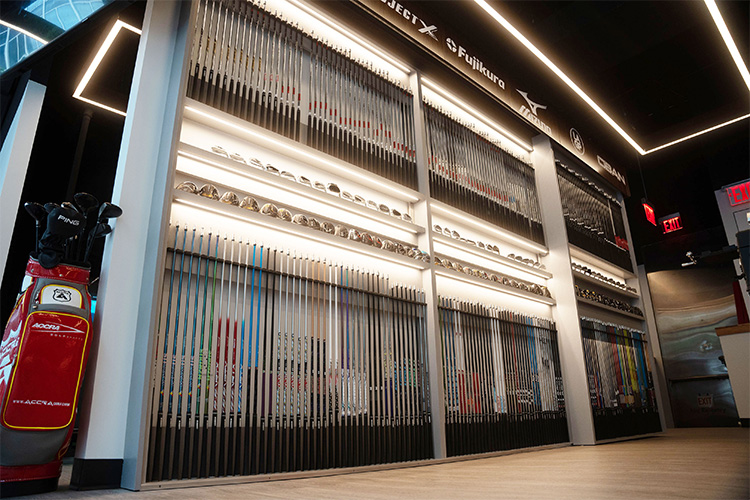
Nick’s goals were multiple. He wanted Club Champion’s fitters to be the smartest in the industry. As he told me, “Having a lot options is great, but the fitting is only as good as the combinations you can think of. No one can realistically master all 65,000 combinations we have.” Nick also wanted to give his fitters more help on difficult fits, pooling the knowledge of all the company’s fitters.
Additionally, Nick noted that AI Co-Pilot allows the fitters to put more focus on the client. Because the fitter is not solely responsible for generating every new idea, they can pay more attention to how the client is swinging and their subjective feedback on each combination. Finally, with his typical candor, Nick told me that shorter fits mean more fits in a day, and that’s just good business.
Building Club Champion AI Co-Pilot
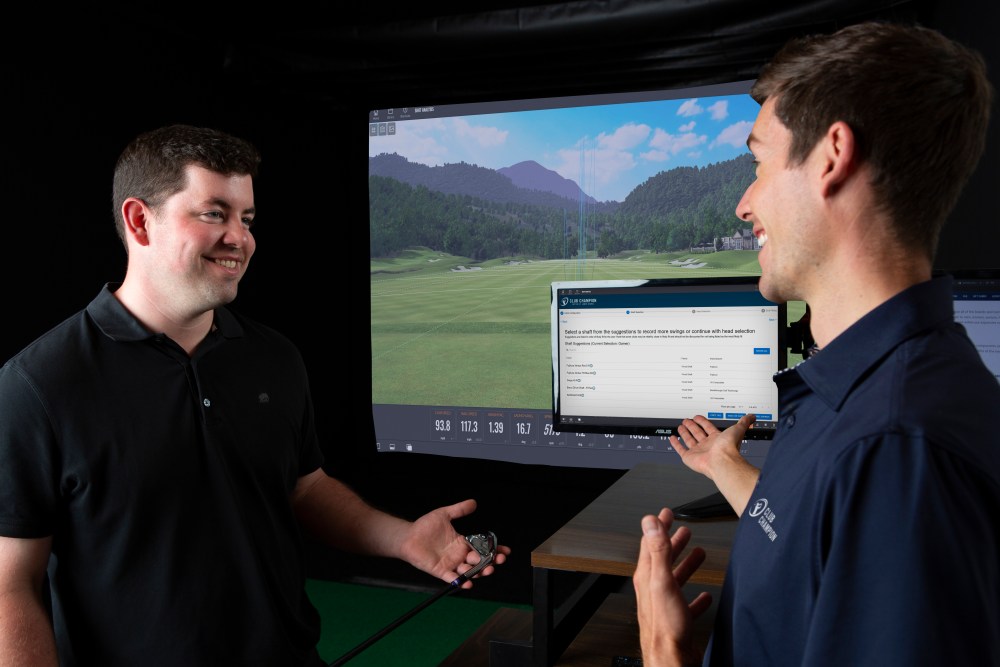
With the concept rooted in his mind, Nick and Inspire11 got to work building the system. He calls it a “predictive learning model” that also leverages Trackman’s Optimizer to help fitters find the best combination of head and shaft for each player. To date, Club Champion has invested over $1.2M in building the software.
While the system is impressive, Club Champion’s real edge is their data. Every Monday, Nick feeds the system roughly 250,000 new shots. That averages out to 1 million shots each month, meaning that Club Champion AI Co-Pilot is currently working with, conservatively, 50 million data points, all based on the swings of real golfers, not theoretical models.
The System in Practice
When Club Champion AI Co-Pilot was first rolled out, Nick said there was some resistance. Veteran fitters, in particular, had difficulty adjusting to this new technology. Now, however, even the oldest fitters have become converts.
Nick told me that newer fitters loved AI Co-Pilot from the jump. Club Champion’s 65,000 combinations can be overwhelming, and AI Co-Pilot provides them a roadmap while they develop their own knowledge.
There’s hard data to show that AI Co-Pilot is meeting some of the lofty goals of its creators. Nick reported that fittings are fifteen minutes shorter, on average. As someone who, like Ryan Cox, wants to hit fewer balls in a fitting, I think this is a major victory. Hitting things can be fun, but who doesn’t want a shortcut to the right answer?
Even more compelling is the way that Club Champion AI Co-Pilot has impacted fitters’ recommendations. In the decade before AI Co-Pilot’s release, one specific OEM was Club Champion’s top-selling OEM every year. In the last three years, every year has seen a different top-seller. This speaks to the way that AI Co-Pilot helps fitters see all the possibilities on the wall rather than getting locked into certain patterns.
Does the Fitter Still Matter?
At this point, the question above asks itself. The answer is a resounding, “Yes.”
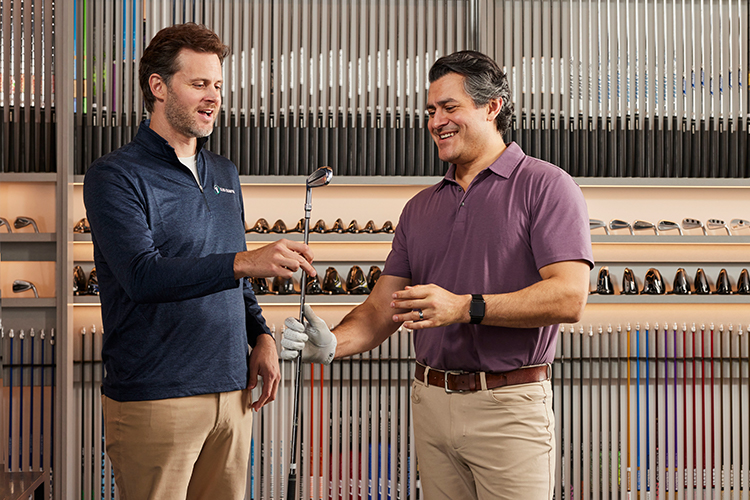
The most important part of any club fitting is the conversation between the player and the fitter. Without an understanding of what the player wants, even a perfect AI system would be clueless. And, yes, AI systems can offer a series of questions, but it can’t replace the understanding of a real golfer.
Nick often refers to Club Champion AI Co-Pilot as the fitter’s “backup brain.” I like thinking of it as a caddie to the fitter’s golfer. Is a caddie helpful? Absolutely. Can it make the difference between a good and great performance? Yes. But can the caddie hit the shots? No.
Additionally, the system is blind to the performance of new equipment until fitters put it to real world use. In this way, the fitter and Club Champion AI Co-Pilot form a virtuous cycle of knowledge building. The fitter uses their knowledge to collect data, the system aggregates the entire company’s data to make recommendations, and the fitters use that to further their own understanding. The final result is better fits.
Do We Still Need Live Fittings?
Another fair question, producing another loud, “Yes.”
AI recommendations are great, but they still need to be confirmed. Nick estimated that Club Champion AI Co-Pilot might be 80% accurate. That’s very impressive, but it also means that without live testing 1 in 5 players would spend their money on clubs that don’t work for them. Getting those shortcut directions is awesome, but you still need to confirm that they’ve taken you where you want to go.
This also ignores the human, subjective element. All fitters and most golfers know that there’s an interaction between the club and the player that is never going to be fully understood by a machine. All the numbers in the world may tell you that Combination #373 is going to optimize you off the tee, but if you can’t stand the look or the sound or the way the shaft feels, the numbers mean nothing.
While club fitting has evolved at a lightning fast pace, the fundamental recommendation of Plugged In Golf holds true. When you’re ready to get new clubs, invest in the best fitting you can if you want to play your best golf.

He founded Plugged In Golf in 2013 with the goal of helping all golfers play better and enjoy the game more.
Matt lives in the northwest suburbs of Chicago with his wife and two daughters.
- Forgeway Golf Ball Review - September 8, 2026
- Wedge Guys Diamond Hybrid Grip Review - September 7, 2026
- Callaway Quantum Mini Spinner Review - September 7, 2026





15 Comments
Seems pretty cool, especially the fact that you don’t need to hit as many balls during the fitting. I’ve had problems getting fatigued during the fittings I’ve gone through.
That being said, I really dislike Club Champion’s business model and am hesitant to go there even though they have the best selection of shafts. Seen way too many people get taken advantage of there. I recently saw someone’s order sheet from an iron fitting and CC tried to charge them an extra $1200 for KBS tour lites on top of the normal iron MSRP price. Those are literally the most basic, non-upcharge shaft option from every OEM but because they were “pured” they were an extra 1200 bucks.
Jarrett,
There’s no doubt that Club Champion is a more expensive option, but there is a pretty simple explanation: they have to buy each component individually, then they weight sort (which OEMs don’t do), then they PURE (we have testing to show its efficacy), and then they build to tighter tolerances. I don’t think it’s accurate to say the $1,200 was for KBS Tour Lite. The final cost may have been $1,200 more than the retail price for the irons alone, but that includes more than the shafts. There are a lot of people who will still say that’s too much, and that’s fine, I don’t spend other people’s money, but I do want the facts laid out accurately.
Best,
Matt
The build sheet lists $1500 for their i540s (7 clubs, retail price) and then there’s a line for 7 KBS tour lite shafts at 170 a piece so $1190. That’s the cost of those shafts built to what they say is basically tour level detail and their pureing service, as you mentioned. So the consumer could order the i540s from another retailer for just the $1500 and not pay any additional cost for those shafts (stock version but still what they were fit into), saving themselves $1200.
My point is that the extra services and cost for those shafts are not necessary for 99% of amateur golfers. I’m sure there is some benefit but it’s marginal and will not matter for the vast majority of players. CC seems to overstate the importance of the extra shaft services and I just don’t like seeing the less informed consumer spend more than they need to.
Jarrett,
Again, you and everyone else are welcome to spend your money – or not spend your money – any way that you want. However, I have a sincere issue with a lot of what you say in your comment.
1) Why do you get to decide that these services are “not necessary for 99% of amateur golfers”? Do you also get to tell people what kind of cars they should drive because they’re not F1 drivers or what kind of clothes they should wear because they’re not runway models? Or, if we stick to golf, do you get to tell people that they shouldn’t buy new clubs at all because their old ones are good enough?
2) On what do you base the statement that the “benefits [are] marginal and will not matter for the vast majority of players”? Have you read our research on PUREing? Have you tested the impact of having a set that doesn’t have a consistent swing weight or proper lengths, lies, or lofts? All those things seem pretty important to me.
3) How many Club Champion fittings have you sat through that you can say they “overstate the importance of the extra shaft services”? I’ve seen literally hundreds over the last fifteen years, and every one has included a clear explanation of the costs and different options.
4) Why do you assume that other golfers are “less informed” than you? Again, Club Champion fittings always include a conversation about price. No one is held at gunpoint and told they have to hand over their credit card. The whole fitting process is about educating the golfer so they can make a good decision for themself.
Once more, you’re certainly welcome to buy your clubs wherever you want. You can join the comments section and say, “Club Champion charges more than I’m willing to pay.” But to make these sweeping statements about what others should or shouldn’t do doesn’t sit well with me.
-Matt
I think you took what I said a little differently than I meant it, which is understandable over written text. I certainly don’t mean to tell anyone what they can or can’t do, and I wouldn’t in a conversation about equipment. I’m not sure the people I play with have even heard of pureing before, it has never come up. I also didn’t mean less informed as derogatory in any way or assume I know more than everyone. Most golfers I interact with are not gear nerds and are much more focused on just practicing/playing when they can. These were just some of my thoughts/opinions.
I certainly think SW, length, loft, lie angle, etc are important. Those things would be covered in a normal fitting though and can be customized when ordering direct from an OEM. Although admittedly they will not always be accurate and can be off by a few points/degrees here and there. CC’s services should in theory get your clubs to a more consistent place than that. I have looked at your article on pureing but haven’t read it over thoroughly, there are some interesting comments I saw about adjustable hosels that I hadn’t thought of.
Would love to see testing that shows benefits of Puring. When I told the fitter, looking down at a particular iron head was distracting – he told me others he fitted with that head didn’t have that problem, left me with no confidence in Club Champion fittings.
https://pluggedingolf.com/does-pureing-a-shaft-improve-performance-golf-myths-unplugged/
Matt,
I had a great experience with the Club Champion fitter during my iron fitting. But when I found out the cost with the custom shafts (which are stock shafts for some OEMS) plus the installation, etc I choose not to pay that much for my clubs. My issue with Club Champion is they don’t offer an option to be fitted with the stock shaft and I did not know this prior to going there or how much more it would cost to buy clubs from them. I wasted my time driving the 2 hour round trip to their store and the time doing the fitting. I ended up ordering the same clubs from another fitter with the stock shafts. The second fitter didn’t charge anything extra. Lesson learned.
I am a believer in club fitting but think that the industry has a long way to go. Hopefully AI will help.
My last iron fitting with CC ignored SW and loft and only addressed lie in a follow up. I was OK with the puring but was somewhat appalled at the shaft price markup. That may be a way to cover the “free” fitting that comes with a custom purchase. If there was a benefit , it was to get the shaft right which I think was accomplished. If I go to a fee based fitter in the future I will pay the fee and make a separate decision around who will build the clubs. Finally I would like to see the industry figure out how to integrate grip size into the fitting process.
Jim,
There are definitely some key things that even the best fitter haven’t figured out how to deal with yet, and grip size is among them.
Best,
Matt
As emphasized at the start and end of the article, a quality club fitting continues to be 100% dependent on a quality fitter!
My own experiences at a Club Champion location were decidedly suboptimal and disappointing….
I hate to beat a dead horse, but over the past five years, I’ve personally seen 5 different, mid-handicappers, who paid exorbitant Club Champion (CC) club fitting fees; only to get their brand new, CC fitted, pured shafted clubs out to play a round with me; and every one of them without fail, still shot over 100 for 18 holes. Sometimes, despite the best club fittings known to mankind; some people just can’t shoot a decent round of golf…no matter how much money they spend.
Your comment loses all credibility with me for the obnoxious “not breaking 100 isn’t a decent round” bit. You may be a real pro, you may be a keyboard pro, but I’d bet heavily on the latter because most people I know who are actually good at things have a lot more grace. A good round is whatever the person playing says it is. If you can only see golf for a number written on a piece of paper, I genuinely feel bad for you.
In spite of that, I’ll bite: no one at Club Champion (or anywhere else) is saying that you can “buy a game.” No one who has ever played believes that the difference between 105 and 72 is a new bag of clubs.
That said, did these 5 different mid-handicappers shoot better scores than they had previously? Did they hit better shots or longer drives? Those would be more meaningful metrics for judging the club fitting. Anyone who has spent any amount of time thinking about the game understands that the final score is a compilation of tons of things. A major piece is course management/strategy. I can have perfect clubs AND hit perfect shots, but I can still shoot a big number if I’m picking bad targets and pulling the wrong club.
I am sick of bad faith or just plain stupid arguments against club fitting. Club fitting is not perfect, it’s an evolving science, but it’s a whole lot better than going without.
-Matt
I’m sorry Matt, I side with the objectors here. I am a past customer of CC. And a repeat customer in fact. I really appreciated the time I spent with my fitter. But I will never go back. The business model is exactly that – business, with the sole objective to line the pockets of stakeholders. I enjoyed the CC process but in the end, none of those clubs are even in my bag any longer. Readers, please save your money and find another fitter. 6 HCI.
Mark,
I don’t view there as being “sides” to this. You tried it, you don’t find value in it…who can argue with that? I never tell people how to spend their money. The only thing I want is an accurate accounting of the facts.
Best,
Matt